
Side-by-side comparison
| Decision point | Breaker bar | Impact wrench |
|---|---|---|
| Setup | Socket and leverage only; no battery, charger, or compressor | Needs a matching battery platform or air supply, plus impact-rated sockets |
| Removal method | Manual breakaway with direct feedback through the fastener | Repeated impacts loosen and spin fasteners with far less hand effort |
| Ownership burden | Minimal storage and upkeep | More bulk, more accessory management, and more system pieces |
| Control around stubborn hardware | Deliberate, quiet, and easier to feel through a binding bolt | Faster and louder, with more vibration and momentum |
| Best rhythm | Occasional repairs, seasonal tire swaps, trunk kits | Repeated wheel work, brake jobs, and suspension teardown |
The core trade-off is simplicity versus speed. The breaker bar is the cleaner tool for sparse jobs because it stays ready without charging, hose management, or compatibility questions. The impact wrench earns its place when fastener removal happens often enough that saved time and reduced fatigue matter more than the extra setup.
Pick the breaker bar for a home garage, roadside kit, or seasonal maintenance routine where low clutter and almost no upkeep matter most. Pick the impact wrench if you already have the right battery platform or compressor and your work comes in batches; it is the more efficient tool for repetitive removals, while the breaker bar remains the easier tool to own.
How This Page Was Built
- Evidence level: Structured product research.
- This page is based on structured product specifications and listing details available at the time of writing.
- Manufacturer documentation, specifications, retailer details, and buyer-fit context were reviewed for this page.
- Use it to judge buyer fit, trade-offs, and purchase criteria rather than lab-style performance claims.
The breaker bar is the better buy for most buyers, because it solves occasional stubborn fasteners with almost no upkeep, while an impact wrench only pulls ahead when the same jobs repeat again and again. That answer flips for frequent wheel service, rusty suspension work, or any setup that already includes a matching battery platform or air compressor. The real choice is simplicity versus speed, not raw force alone.
Quick Verdict
Quick verdict: buy the breaker bar for seasonal repairs, low clutter, and the lowest ownership burden. Buy the impact wrench for repetitive removals, tight schedules, and any workflow where hand effort costs more than tool complexity.
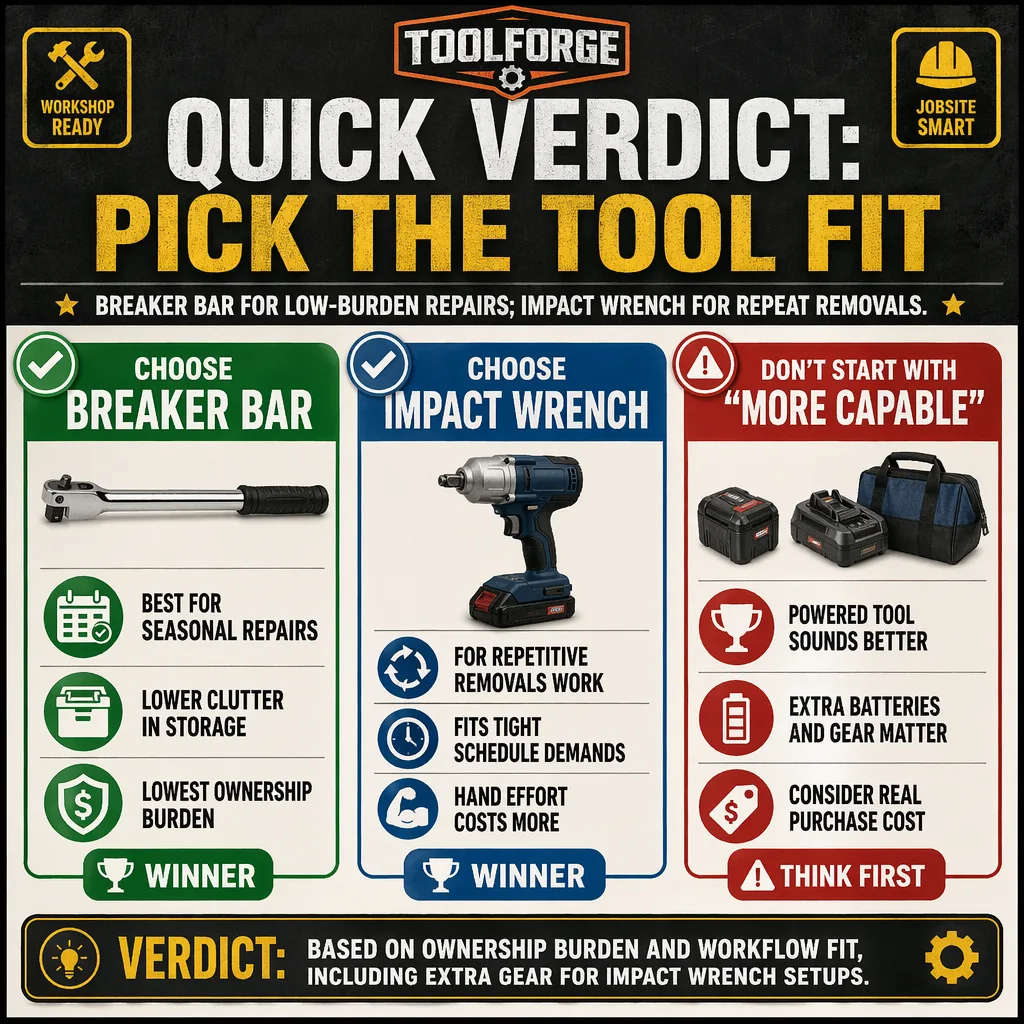
Most guides put the powered tool first because it sounds more capable. That is the wrong starting point for a casual garage. The extra gear around an impact wrench, batteries, charger, or compressor, changes the real purchase more than the wrench itself.
What Separates Them
The impact wrench wins on speed. It uses repeated impacts to break loose fasteners quickly, then spins them off with far less hand effort than a manual tool. The breaker bar wins on simplicity, because it is just leverage, a socket, and your own force.
That difference matters more than headline torque talk. A breaker bar never waits on a charge, never needs a battery swap, and never asks where the charger went. An impact wrench arrives with more momentum, but it also brings more moving parts to keep organized.
There is a common misconception here: more torque does not settle the comparison. A tool that feels stronger on paper still loses if it adds storage clutter, socket compatibility questions, and battery upkeep to a job that happens twice a year.
Everyday Usability
A breaker bar is the easier tool to own when the work is occasional. It lives on a shelf, in a trunk kit, or near the bench and stays ready without a checklist. For one-off brake work, a stuck bracket bolt, or a seasonal tire swap, that simplicity matters more than speed.
An impact wrench changes the workflow. You need the wrench, the right battery or air supply, and impact-rated sockets for the best fit. That extra setup is minor in a shop that uses the tool all day, but it feels like friction when the job is only two bolts and a wheel.
Noise and control separate the two in daily use. The breaker bar is quiet and deliberate, which helps when fasteners are exposed, rusty, or close to fragile hardware. The impact wrench is faster and louder, but it adds vibration and a little more risk of overdoing a fastener if attention slips.
Winner for everyday simplicity: breaker bar.
Winner for repetitive speed: impact wrench.
Capability Differences
The impact wrench wins when the same fasteners come apart over and over. Lug nuts, brake work, and recurring maintenance jobs reward a tool that removes the hardest part first, especially when fatigue is the real bottleneck. In that setting, the extra setup pays off.
The breaker bar wins when the job calls for feel. A stubborn bolt that starts to move, then binds again, gives useful feedback through a manual tool. That direct feedback helps on cramped hardware where a power tool feels bulky or where the fastener needs patience, not speed.
One practical detail matters here: the tool is only part of the system. A weak battery or an undersized compressor turns an impact wrench into a noisy disappointment, while a well-made breaker bar keeps doing the same thing no matter what sits in the outlet. That is why the manual tool keeps its appeal in garages that value reliability over acceleration.
Capability winner for repetitive fastener removal: impact wrench.
Capability winner for controlled breakaway on simple jobs: breaker bar.
The First Filter for This Matchup
The first filter is the rest of your setup, not the tool headliner. If you already own a cordless line that matches the wrench, the powered option gains value fast. If you own a basic socket set and no charger wall, the breaker bar fits the garage with less friction.
The second filter is job frequency. One car, a few times a year, fits a breaker bar. Multiple vehicles, frequent wheel swaps, or regular undercar work fits an impact wrench much better. That is the part most buyers miss, because they shop the tool and ignore the system around it.
Decision checklist
- Choose a breaker bar if you want one tool that always works.
- Choose a breaker bar if storage is tight and you want no batteries, charger, or compressor.
- Choose an impact wrench if you already own a compatible battery platform or air setup.
- Choose an impact wrench if you remove the same fasteners in batches.
- Choose a breaker bar if the job list is sparse and predictable.
Best Fit by Situation
Best-fit scenario box
- Seasonal tire rotation, one vehicle, basic garage setup: breaker bar
- Brake jobs, suspension teardown, repeated wheel work: impact wrench
- Roadside kit or trunk storage: breaker bar
- Shared shop or frequent service work: impact wrench
A breaker bar suits the buyer who wants the simplest path from storage to action. It stays useful even if the garage is cold, the battery is dead, or the compressor is on the other side of the room. The trade-off is slower removal on bigger jobs.
An impact wrench suits the buyer who values speed and already accepts the support gear. It shortens repetitive work, but it introduces battery management, socket requirements, and more bulk around tight access points. Buyers who hate extra systems usually regret this purchase first.
Upkeep to Plan For
The breaker bar has almost no upkeep burden. Wipe it off, store it dry, and keep the square drive clean. That is the whole routine for most owners, which is why the tool remains appealing as a long-term basic.
The impact wrench brings more upkeep because it is part of a system. Cordless versions add battery storage and charging discipline. Pneumatic versions add hose management, compressor upkeep, and moisture control. The tool itself is only one piece of the ownership cost.
Another practical difference sits in the drawer. The breaker bar does not ask for matching accessories. The impact wrench often pushes buyers toward impact-rated sockets, a battery ecosystem, or a compressor upgrade, and that is where the “simple” purchase stops feeling simple.
Winner for upkeep: breaker bar.
Published Details Worth Checking
Drive size matters, even in a broad comparison. The socket set already on hand should match the tool, and the impact wrench should pair with impact-rated sockets rather than delicate chrome pieces. That compatibility issue matters more than cosmetic features.
For an impact wrench, check the power source first. Cordless models make battery compatibility part of the purchase. Air models make compressor output and hose setup part of the decision. A strong-sounding wrench with weak support gear behaves like a smaller tool in practice.
For a breaker bar, check handle length, head access, and how the tool fits your most common fasteners. A bar that feels too short invites bad habits, like grabbing a pipe extension instead of buying the right tool. That shortcut creates more risk than value.
Also check the package contents. A bare impact wrench with no battery, no charger, and no proper sockets changes the value story immediately. A breaker bar package is simpler, but the socket set around it still matters.
Who Should Skip This
Skip the impact wrench if the garage sees only a few service jobs a year and there is no matching battery ecosystem or compressor already in place. In that setup, the extra gear turns convenience into clutter.
Skip the breaker bar if repeated wheel work, brake service, or suspension teardown fills the calendar. In that case, the slower tool becomes the annoying tool, and annoyance has a real cost during busy weekends.
Common mistakes box
- Mistake: using either tool as the final tightening tool. Wrong. Final tightening belongs to a torque wrench.
- Mistake: assuming a ratchet and a breaker bar do the same job. Wrong. A ratchet turns fast, a breaker bar breaks loose stubborn fasteners.
- Mistake: putting standard sockets on an impact wrench. Wrong. Impact-rated sockets belong on the powered tool.
Value by Use Case
The breaker bar gives the clearest value for occasional buyers. It costs little to own in practical terms, because it brings no battery upkeep, no charger, and no platform lock-in. For a tool that sits idle between jobs, that matters more than speed.
The impact wrench gives the better value only when the time savings repeat. If it shortens a lot of wheel work, brake work, or teardown work, the extra complexity earns its keep. If it sits between uses, the battery and accessory burden makes it a louder purchase than a better one.
Secondhand buying shows the same pattern. A breaker bar stays useful because little about it ages. An impact wrench demands a closer look at batteries, charger, and trigger health before it earns a spot in the cart. That makes the manual tool the safer low-risk choice for buyers who want fewer surprises.
The Practical Choice
Buy the breaker bar if you want the most practical answer for a home garage, roadside kit, or occasional repair setup. It is the better fit for the most common use case because it works without charging, without platform lock-in, and without extra ownership chores.
Buy the impact wrench if your fasteners come off in batches and you already own the support gear it needs. That is the better choice for frequent wheel work, regular brake jobs, and any shop-style workflow that values speed over minimal setup.
For most buyers, the breaker bar fits better. The impact wrench wins only when repetition, speed, and existing compatibility turn the extra system into an advantage.
FAQ
Do I still need a torque wrench?
Yes. Neither an impact wrench nor a breaker bar replaces a torque wrench for final tightening. Use the breaker bar or impact wrench to remove or snug fasteners, then finish with measured torque.
Which tool handles stuck lug nuts better?
The impact wrench wins for repeated lug nut removal because it removes the slow part of the job quickly. The breaker bar wins when you need controlled leverage on a single stubborn fastener and want more feel in the process.
Is a breaker bar good enough for home repairs?
Yes. It handles the jobs that matter most to casual owners, especially when speed is not the priority. The trade-off is that large or heavily corroded fasteners demand more effort from the user.
What do I need to buy with an impact wrench?
You need the power system that matches the wrench, plus impact-rated sockets. A bare wrench without those pieces adds friction instead of reducing it.
Is an impact wrench overkill for occasional use?
Yes, if the tool comes into play only a few times a year and there is no compatible battery or air setup already in the garage. In that case, the breaker bar delivers the better ownership experience.
Does a breaker bar work with any socket set?
It works with standard sockets, and that is part of its appeal. The main check is fit and drive size, not a battery platform or charger.
Which tool is better for a beginner?
The breaker bar is easier for a beginner to own and store. It asks less of the setup and less of the budget, but it also asks for more manual effort on stubborn hardware.