
Side-by-side comparison
| Topic | Circular saw | Miter saw |
|---|---|---|
| Workflow | Follows the material and moves from job to job | Turns one bench into a fixed cut station |
| Space and setup | Stores easily, travels easily, and needs only a straightedge and clamps | Needs bench space, clear infeed/outfeed room, and a cleanup plan |
| Cut pattern | Handles long boards, sheet goods, repairs, and framing | Speeds repeat crosscuts, baseboards, casing, and other trim |
| Control burden | Demands more measuring and line tracking on each cut | Reduces attention once the station is squared and parked |
| Maintenance | Lighter upkeep: blade, guard dust, and shoe flatness | More calibration: fence square, detents, bevel lock, and dust buildup |
The core trade-off is mobility versus repetition. The circular saw is the lower-friction tool for mixed work because it leaves the bench free and adapts to repairs, framing, and plywood without claiming permanent space. The miter saw is the sharper workflow for a stationary shop because it makes the same crosscut or angle over and over with less setup on each piece.
Choose the circular saw if the saw has to travel, storage is tight, or the project list changes often. Choose the miter saw if the work is trim-heavy, the cuts repeat at the same length or angle, and a dedicated bench station already makes sense.
Safety and Fit Boundary
Quick Verdict
Buy the circular saw first if one tool has to cover repairs, framing, and sheet goods. Buy the miter saw first if the shop already has a bench and the project list is trim-heavy.
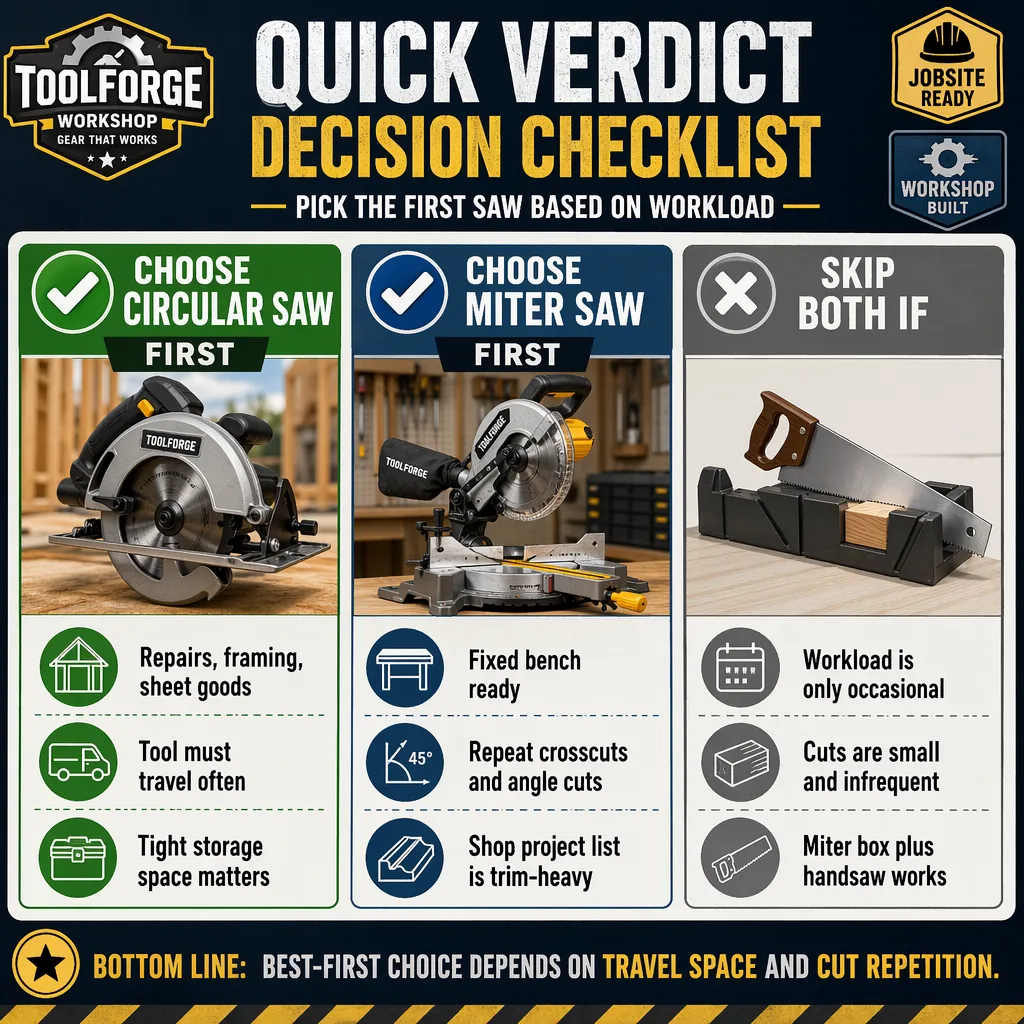
Decision checklist
- Choose the circular saw if the tool has to travel or store in a tight space.
- Choose the miter saw if repeat crosscuts and angle cuts happen on a fixed bench.
- Skip both as the first powered saw if the workload is only occasional small cuts, a miter box and handsaw cover that use case.
The common mistake is assuming the miter saw is the more general tool because it looks more precise. It is not. It is a better station for one kind of work, while the circular saw covers more ground with less commitment.
What Separates Them
The real split is not blade size or brand polish, it is workflow. The circular saw handles work that moves, while the miter saw turns one spot into a cut station. That difference matters more than most product pages admit.
circular saw
The circular saw is the lower-friction tool. circular saw stores easily, travels easily, and handles framing lumber, repairs, and sheet goods without demanding a permanent place in the garage. It fits a straightedge, a clamp, and a support surface, which keeps the tool flexible.
The trade-off is real. Every cut asks for more measuring and more attention to the line, because the saw follows the material instead of locking the material into a station.
miter saw
The miter saw is a repeat-cut machine. miter saw excels when the same angle or the same length shows up over and over, which is why trim work and short stock feel faster on it. Once the saw is squared and parked on a bench, the workflow stays steady.
The trade-off is the footprint. It asks for bench space, clear infeed and outfeed room, and a cleanup plan for chips and dust before it feels useful.
Trade-off: The circular saw reduces storage and setup burden. The miter saw reduces thinking per cut.
Everyday Usability
First-week ownership usually reveals the better fit. The circular saw comes out for a repair, a shelf, a deck board, or a sheet of plywood, then goes back on the shelf with little ceremony. That low-friction pattern suits a home shop that changes jobs every week.
The hidden cost with a miter saw is not the cut itself, it is the station. Once the saw sits in place, the bench stays committed, the workspace needs clearing, and the cutoffs collect around the stand. That setup pays off only when enough boards pass through it to justify the footprint.
For day-to-day use, the circular saw wins for most general buyers. The miter saw wins only when a dedicated cut zone already exists.
Where the Features Diverge
The biggest difference shows up in what each saw does without extra help.
- Repeatable crosscuts: miter saw wins.
- Long boards and sheet goods: circular saw wins.
- Portability: circular saw wins.
- Bench-based trim work: miter saw wins.
- Straight line control with a guide: circular saw wins.
- Fast angle repetition: miter saw wins.
Most guides frame the circular saw as a rough-cut tool. That is wrong. A circular saw paired with a straightedge handles clean straight cuts in plywood and trim stock, but the user still carries the measuring and alignment burden. The miter saw removes more of that burden once the stock reaches the station.
A miter saw does not automatically make a cut more accurate. It makes repeatable cuts easier to control, which matters most when the same angle shows up ten times in a row.
Best Fit by Situation
Best-fit scenario box: If the next project list mixes drywall patches, shelving, and one fence repair, start with the circular saw. If the next project list is trim, casing, and repeat angle cuts, start with the miter saw.
The First Filter for This Matchup
The first filter is where the material lives. A circular saw follows the material, while a miter saw requires the material to come to it. That sounds simple, but it decides the tool that gets used instead of the tool that sits in the corner.
That is why a circular saw plus a straightedge solves more one-off cuts than a miter saw on a folding table. The circular saw does not need a permanent station to stay useful. The miter saw pays back its space only after the project rhythm turns repetitive enough to make the station feel natural.
For anyone building around a crowded garage or a shared work area, the filter is blunt. If the saw must travel, the circular saw fits. If the saw stays parked, the miter saw fits.
Upkeep to Plan For
The circular saw asks for lighter upkeep. Keep the blade matched to the material, clear dust from the guard, and check that the shoe stays flat on the work. The maintenance burden stays low because the tool has fewer alignment points that affect every cut.
The miter saw asks for more attention. Fence square, detent cleanliness, bevel alignment, and dust buildup all affect cut quality, especially on trim work where tiny errors show up fast. That matters even more on a used saw, because fence wear and sloppy locks reveal abuse quickly.
Trade-off: A circular saw needs better cut setup. A miter saw needs better calibration.
Winner on upkeep simplicity, circular saw.
What to Verify Before Buying
The published details matter most around space, cut type, and repeatability.
- Confirm the work surface you have, not just the floor space the saw body occupies.
- Check whether the project list leans toward repeated angles or one-off cuts.
- If bevel work is routine, verify the listed bevel capability and whether the head design matches that use.
- If the saw has to move often, make sure the carry and setup burden fits your storage plan.
- If you choose a circular saw, plan for a straightedge and clamps. Without them, straight cuts take more time.
- If you choose a miter saw, inspect the fence, detents, and bevel lock carefully, especially on a used unit.
Most guides push a sliding miter saw as the safer upgrade. That is wrong for small shops because sliding hardware adds footprint and cleanup burden that basic crosscuts do not need.
Edge-case callout: bevels, portability, and accuracy. Bevel-heavy trim work pushes toward the miter saw. Portable jobs push toward the circular saw. Accuracy follows setup either way, but the miter saw holds repeat angles with less attention once the station is square.
When Another Option Makes More Sense
Skip the circular saw as your only saw if the work is mostly baseboard, casing, or other short trim that repeats at a bench. That job belongs on a miter saw.
Skip the miter saw if the work moves between rooms, involves plywood, or lives in a garage that also stores bikes, bins, and lawn gear. That is circular saw territory.
Skip both if your workload is a few small cuts a year. A miter box and handsaw store flatter, cost less space, and avoid the cleanup burden of powered cutting.
A circular saw plus straightedge fits mixed DIY and sheet-good work. It does not fit repetitive finish trim as well as a miter saw. A miter saw fits trim stations and repeat angles. It does not fit mobile work or sheet breakdown nearly as well.
Price and Value
Value is not the purchase sticker alone. It is the total burden of owning the tool.
The circular saw wins value for most shoppers because it covers more project types, stores easier, and asks for less dedicated setup. One tool handles repairs, rough carpentry, sheet goods, and jobsite work without claiming a permanent corner of the shop.
The miter saw wins value only when the workflow stays repetitive. In a trim-heavy shop, the time saved on repeated crosscuts matters. Outside that lane, the extra footprint becomes dead cost.
A used miter saw deserves closer inspection than a used circular saw, because fence wear and angle-lock issues change the cut more than cosmetic wear does. A used circular saw shows its problems more plainly in the shoe, guard, and blade condition.
Bottom Line
Buy the circular saw first if the saw has to travel, store easily, or cover mixed projects. Buy the miter saw first if the bench already exists and the cuts repeat at the same angle and length.
Decision lens
- Choose the circular saw for repairs, framing, sheet goods, and tight storage.
- Choose the miter saw for trim installs, baseboards, casing, and repeat crosscuts.
- If both jobs sit on the list, start with the circular saw and add the miter saw only when the workflow proves it earns a fixed station.
The right first purchase matches the shape of the work, not the sharpness of the marketing.
The Practical Choice
For the most common buyer, the circular saw fits better. It asks for less space, serves more job types, and stays useful when the project changes from one week to the next.
Buy the miter saw only if the main use case is bench-based trim work, repeated crosscuts, or a dedicated workshop station. That is the better tool inside that narrower lane, but it stays a specialization.
FAQ
Is a circular saw enough for most DIY projects?
Yes. A circular saw handles repairs, framing, plywood, shelving, and other mixed projects with less storage and setup burden than a miter saw. It loses ground when the work turns into repeated trim cuts.
Is a miter saw more accurate than a circular saw?
It delivers more repeatable accuracy for crosscuts and angles at a fixed station. A circular saw with a straightedge handles straight cuts well, but it asks the user to manage more of the setup.
Which tool handles baseboards and casing better?
A miter saw handles baseboards and casing better because the cuts repeat and the stock stays short. A circular saw fits only when the job is small, mobile, or temporary.
Which tool handles plywood better?
The circular saw handles plywood better because sheet goods need support across a long cut path. A miter saw is the wrong tool for breaking down large sheets.
Do I need a sliding miter saw?
Only if wider stock or longer crosscuts show up often. Sliding hardware adds footprint and cleanup burden, so it makes sense only when the extra reach solves a real job pattern.
Which is easier to store in a small garage?
The circular saw is easier to store in a small garage. It leaves the bench free and does not claim a permanent station.