
Side-by-side comparison
| Topic | Circular Saw | Chop Saw |
|---|---|---|
| Workflow | Follows the cut line and moves with the project | Brings the blade down to stock at a fixed station |
| Space and setup | Low storage burden, little dedicated setup | Needs a stable bench area and clearance around the cut |
| Material range | Handles sheet goods, long boards, and mixed jobs | Suits short lumber, trim stock, and repeated crosscuts |
| Accuracy control | Relies more on layout, support, and a straightedge or guide | Fence-driven workflow reduces measuring and rechecking |
| Upkeep focus | Clean base, free guard, sharp blade | Clean fence, clear detents/angle stops, dust-free base area |
The core trade-off is portability versus repetition. A circular saw covers more ground because it can follow the project, cut panels and long stock, and work in rooms, garages, or jobsites without claiming a permanent footprint. A chop saw narrows the job but speeds it up: once the stock reaches the bench, the fixed fence and repeated setup make short, repeat cuts move faster and stay more consistent.
Choose the circular saw if your work shifts between spaces, involves sheet goods, or needs one tool that can handle repairs, framing, and general cutting without building a dedicated station around it. Choose the chop saw if your cut list stays short, repetitive, and centered on a bench, where the same measurements and angles come up again and again.
How This Page Was Built
- Evidence level: Structured product research.
- This page is based on structured product specifications and listing details available at the time of writing.
- Manufacturer documentation, specifications, retailer details, and buyer-fit context were reviewed for this page.
- Use it to judge buyer fit, trade-offs, and purchase criteria rather than lab-style performance claims.
A circular saw is the better buy for most buyers because it handles more jobs with less space, less setup, and less friction between cuts. A chop saw takes the lead only when the work stays at a fixed bench and the cut list repeats. If your material moves around the house, garage, or jobsite, the circular saw wins. If the board comes to you every time, the chop saw pulls ahead.
Quick Verdict
The real split is not cutting power. It is ownership burden.
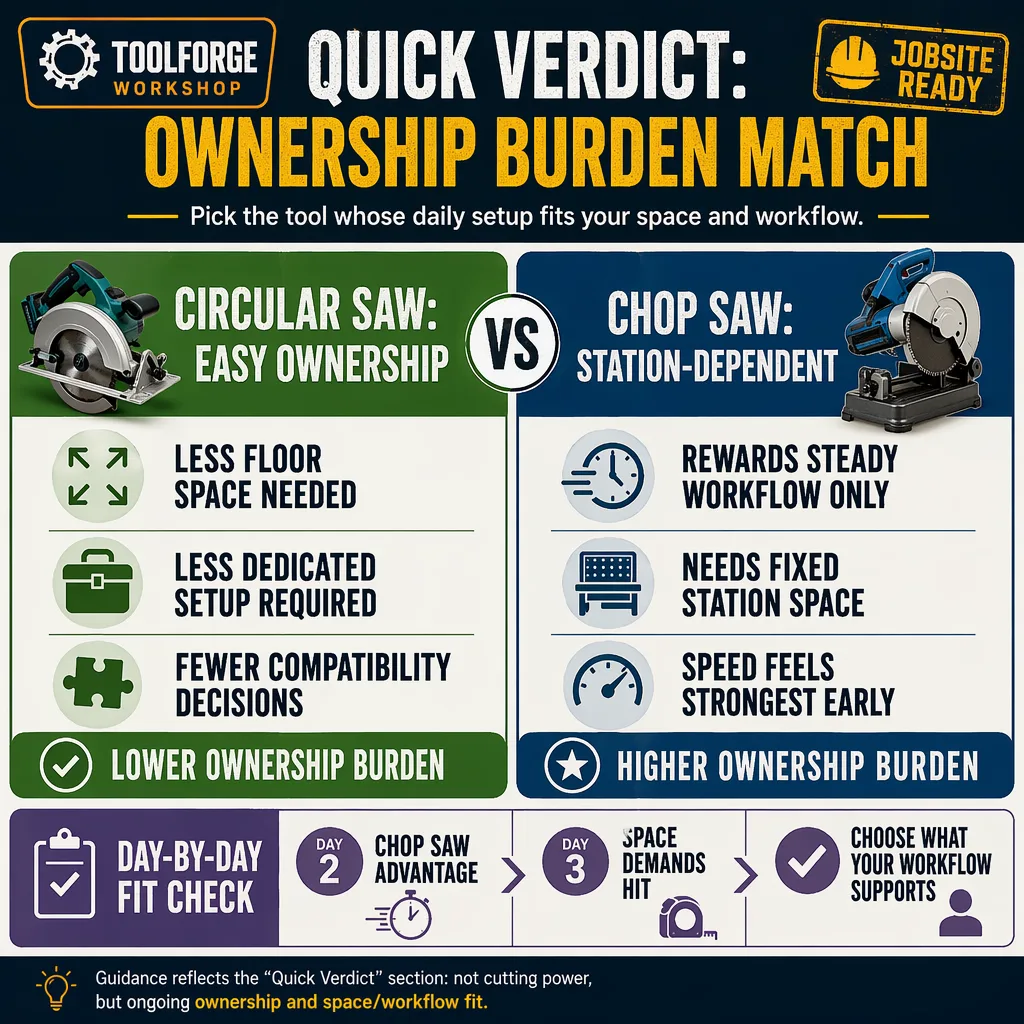
A circular saw asks for less floor space, less dedicated setup, and fewer compatibility decisions. A chop saw rewards you only when the workflow is steady enough to justify a fixed station. Most buyers feel the chop saw’s speed on the second day, then run into its space demands on the third.
What Separates Them
A circular saw follows the cut line. A chop saw fixes the work in place and brings the blade down to it. That sounds simple, but it changes everything about accuracy, workflow, and annoyance cost.
Most guides blur chop saws and miter saws. That is sloppy. The buyer decision still comes down to the same core issue, portable cutting versus stationary repeat cutting, even if some shoppers use the terms loosely.
circular saw: the flexible first buy
The circular saw is the better match for mixed jobs, remodel work, framing, and any task where the material sits too long or too awkward to move onto a bench. It also handles sheet goods far better than a chop saw, which matters the first time a project involves plywood or long boards that do not fit a station cleanly.
The trade-off is control. A circular saw asks for layout, support, and, for clean repeat cuts, a straightedge or guide. Skip those supports and the saw starts feeling less precise than it really is.
chop saw: the stationary repeat-cut tool
The chop saw wins when the cuts repeat and the work stays short enough for a fixed station. Trim stock, short lumber, and batch cuts move faster because the fence and stop-like workflow reduce measuring and rechecking. That speed comes from the setup, not from magic.
The trade-off is obvious. It needs room, a stable station, and a place to live. If the saw has no home, the convenience disappears fast.
How They Feel in Real Use
A circular saw feels like a tool that follows the project. That is useful on site repairs, deck work, and anything that moves from room to room. The downside shows up when the cut needs to look finished right away, because every accurate cut asks for more planning and more support.
A chop saw feels like a tool that removes decision-making after the stock reaches the bench. Once the fence is set and the station is clear, repeated cuts go faster and stay more consistent. The downside shows up when the material is oversized, because the saw slows down as soon as the stock stops fitting the station.
Safety and setup differ in a practical way. A circular saw demands more attention to the blade path and more support under the work. A chop saw looks more controlled, but it still punishes sloppy clamping and bad hand placement. Most guides sell the chop saw as the “safer” pick. That is incomplete. The safer tool is the one that matches the way the material actually gets handled.
The First Filter for This Matchup
Ask one question first: does the material come to a fixed spot, or does the saw need to travel?
If the answer is fixed spot, the chop saw fits the job. If the answer is travel, the circular saw fits better. That first filter matters more than brand, blade count, or accessory bundles because a tool that fights the workflow becomes annoying long before it becomes worn out.
Best-fit scenario box
Buy a circular saw if the work moves between rooms, garages, and job sites.
Buy a chop saw if the cuts repeat at the same bench and stock length stays manageable.
The hidden cost of a chop saw is not the blade. It is the space it claims, plus the clear area needed on both sides of the cut. A circular saw avoids that burden entirely.
Where One Goes Further
The circular saw goes further in job coverage. It breaks down sheet goods, trims lumber in place, and travels anywhere the project moves. That broader reach makes it the better first purchase for most buyers.
The chop saw goes further in batch precision. It excels when the same measurement repeats and the angle stays consistent. That is why it feels faster on a trim run or any cut list that rewards rhythm.
A common mistake is assuming a circular saw is automatically the rougher tool. That is wrong. A circular saw with a good blade and a straightedge cuts cleanly enough for many finish-adjacent jobs. The real difference is how much setup the tool asks for before it gets there.
Best Fit by Situation
Decision checklist
- Need to move the saw? Pick the circular saw.
- Need repeat crosscuts at one station? Pick the chop saw.
- Need both? Buy the circular saw first.
Routine Checks
Maintenance stays light on both tools, but the burden lands in different places.
A circular saw needs a clean base, a free-moving guard, and a blade that stays sharp enough to cut without wandering. A dull blade gets blamed for accuracy problems that actually start with the blade edge. Keep the work supported and the saw stops feeling temperamental.
A chop saw needs a clean fence, clear detents or angle stops, and a station free of packed dust and offcut debris. If the fence faces get dirty or the base area fills up, repeatability drops fast. That loss shows up in small alignment annoyances long before it turns into a full repair issue.
What To Verify Before Buying
Check the stock you cut most often, then check the space around the saw.
If you cut long boards, panels, or installed material, the circular saw fits better because the work stays manageable. If you cut short pieces at a bench, the chop saw fits better because the station does the alignment work for you.
Also check whether you need a guide or straightedge, since that accessory changes the value of a circular saw a lot. For a chop saw, check whether your workspace gives you room for infeed and outfeed support. A saw with no support area becomes a nuisance fast.
Common mistakes box
- Buying a chop saw for sheet goods.
- Expecting a circular saw to stay accurate without a guide.
- Forgetting the floor space a chop saw consumes.
- Blaming the saw before checking blade condition and work support.
Who Should Look Elsewhere
Look elsewhere if your work is mostly cabinetry, furniture joinery, or finish cuts that need a different class of saw altogether. Neither tool is the cleanest primary answer there.
Look elsewhere if you cut in tight spaces and never get a real bench area. A chop saw will fight that setup from day one. Look elsewhere if your projects involve panels, long boards, or on-site repairs more than batch cuts, because the circular saw already fills that role better.
The mistake is buying the prettier station tool because the cuts look easier on paper. The tool that fits the space gets used. The tool that demands a space gets pushed aside.
Value by Use Case
The circular saw gives the better value for a first purchase because it covers more jobs with less storage burden. It also avoids the hidden cost of building a permanent station just to make it useful.
The chop saw gives better value only when repeated crosscuts dominate the work. In that case, it saves measuring time and makes the cut list move faster.
Accessories change the math. A straightedge or guide improves the circular saw fast. A stable bench setup, clearance, and clean fence surfaces improve the chop saw fast. The cheaper-looking tool is not always the cheaper one to live with.
The Practical Takeaway
Buy the circular saw first if you want one tool for repairs, rough framing, sheet goods, and occasional precision work. Buy the chop saw first only if your cuts stay short, repetitive, and centered on a fixed station.
If the choice still feels close, ask which tool removes more friction from the next three projects. That answer decides the better purchase faster than any feature list.
Which One Fits Better?
The circular saw fits better for most buyers. It wins on portability, storage, and overall job coverage, and those are the things that decide whether a tool stays useful after the first few projects.
Buy a chop saw instead when the work lives at a bench and repeated crosscuts matter more than flexibility. For everyone else, the circular saw is the cleaner first buy.
FAQ
Can a circular saw replace a chop saw?
Yes, for many jobs. A circular saw replaces a chop saw well when you use a straightedge or guide and accept a little more setup time for repeat cuts. It does not replace the chop saw’s batch-speed advantage at a fixed station.
Which tool cuts more accurately?
A chop saw wins on repeat crosscuts and angle consistency. A circular saw cuts accurately too, but it depends more on layout, support, and the guide you use.
Is a chop saw safer than a circular saw?
A chop saw feels more controlled because the stock stays on a fixed station, but safety still depends on clamping, hand placement, and a clean work area. A circular saw asks for more operator control and more attention to support under the material.
Which one is better for sheet goods?
The circular saw is better for sheet goods. The chop saw runs into space and support limits as soon as the material gets large.
Do I need both?
No. Start with a circular saw if your work moves or covers multiple job types. Add a chop saw only when repeated bench cuts show up often enough to justify the space.
What is the biggest buying mistake here?
Buying a chop saw without a real place to use it. The second-biggest mistake is expecting a circular saw to stay accurate without a guide or straightedge.