
Safety and Fit Boundary
Follow the product manual, use appropriate PPE, and respect local code or professional requirements. If the job involves electrical work, structural risk, fuel-burning equipment, or unfamiliar cutting tools, bring in a qualified professional.
The Short Answer
A track saw earns its keep on long, supported cuts where edge quality matters. It handles large panels with less wrestling than a table saw and leaves a cleaner line than a freehand circular saw cut. That is the real reason it wins jobs in small shops and on finish work.
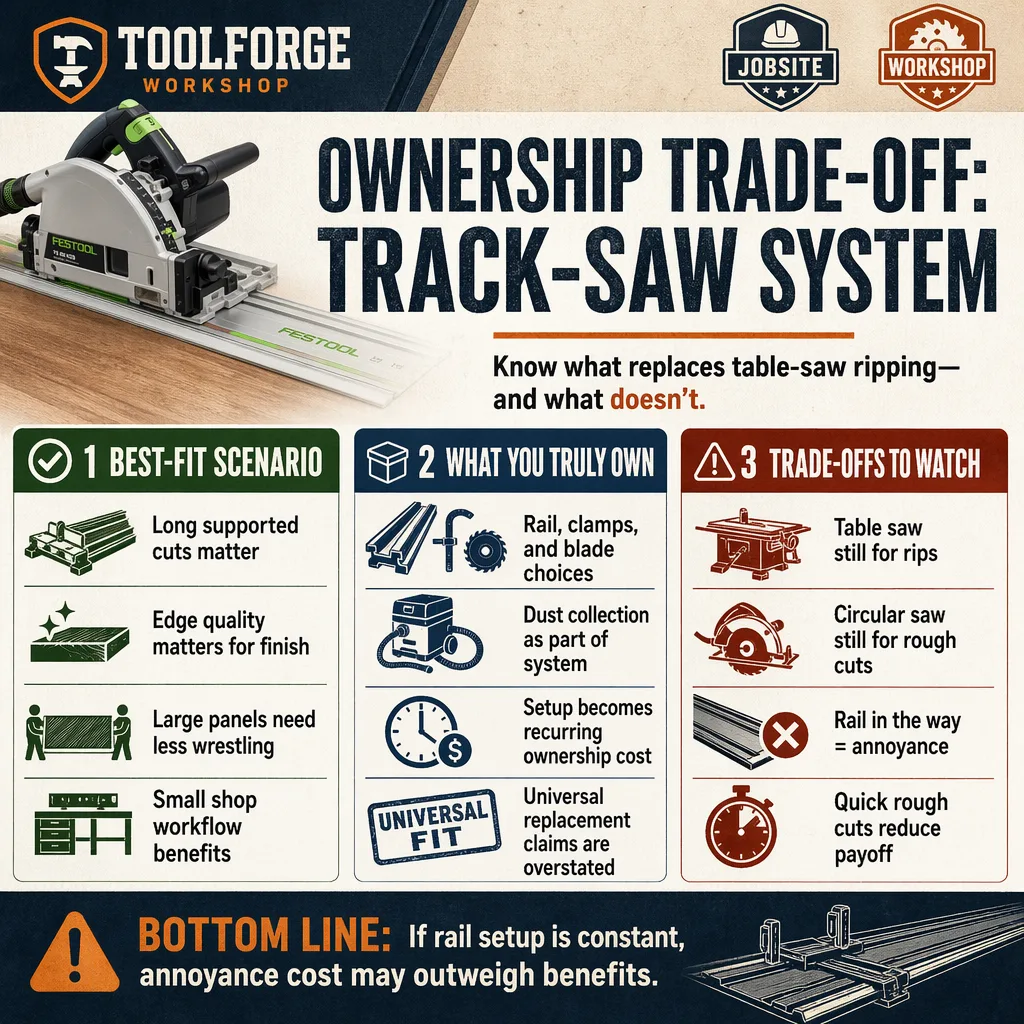
The trade-off is a system, not a single tool. The rail, clamps, dust collection, and blade choices all become part of ownership. Most guides sell a track saw as a universal replacement for a table saw. That is wrong because repeat rip work still belongs to the table saw, and rough cuts still belong to the circular saw.
This makes the purchase less about raw capability and more about annoyance cost. If the rail lives in your way, or if the saw will spend its life doing quick rough cuts, the setup burden outweighs the benefit.
Best-fit scenario box
- Breaking down plywood and MDF
- Trimming doors and finish parts
- Small garage shops with no room for a table saw
- Jobsite cuts where straightness matters more than speed
What This Analysis Is Based On
This read focuses on the ownership decisions that change day-to-day usefulness: setup friction, rail dependence, workpiece support, dust handling, and the kinds of cuts buyers actually make. The exact package matters because a track saw does not work as a standalone promise, it works as a system.
The rail is not an accessory in the casual sense. It is the thing that creates the straight cut buyers want in the first place. That makes compatibility, storage, and replacement parts part of the purchase, not add-ons to think about later.
The evaluation also compares the tool against the saws people already own. That matters more than catalog language. A tool that sounds precise in a listing still creates frustration if it slows down the kind of cutting your shop does most.
Where It Makes Sense
A track saw fits best where large material and clean edges collide. It reduces the awkward handling that comes with forcing full sheets through a fence, and it gives cleaner results on plywood and finish surfaces than a rough-cut setup. That is why cabinet work, trim work, and small-shop panel breakdown keep coming back to it.
| Scenario | Why it fits | Trade-off |
|---|---|---|
| Breaking down plywood or MDF | Clean straight cuts on supported sheets | Rail setup and storage add friction |
| Trimming doors and finish panels | Controlled cuts with less edge cleanup | Overkill for small, one-off cuts |
| Small garage or basement shop | Compact footprint versus a table saw | Repeat ripping stays slower than a fence-based saw |
| Jobsite work on sawhorses | Portable straight cuts without a big station | Dust hose and rail management take attention |
Common misconception: a track saw replaces every saw in the shop. That is wrong. It replaces the awkward part of panel handling and the messier side of straight cuts. A table saw still wins for repeat rips, and a miter saw still wins for quick angle and crosscut work.
The ownership burden is real, though. The rail has to stay flat, clean, and protected. A nicked track edge, a worn splinter strip, or a bent connector turns a precision tool into a fussy one.
The First Filter for Track Saw
The first question is not blade size or motor strength, it is cut pattern. If most of the work is sheet goods, long trims, or finish cuts on panels, the track system earns its place. If most of the work is rough lumber, short crosscuts, or framing, the rail becomes extra baggage.
Use this filter before comparing brands or kits:
- Do you break down sheet goods regularly? If yes, keep going.
- Do you want clean straight cuts without a table saw footprint? If yes, keep going.
- Do you have a flat support surface and a place to store the rail? If no, stop.
- Do you mainly cut framing lumber or scrap? If yes, skip the track saw.
That is the decision point most shoppers miss. They focus on precision and ignore the setup routine that makes precision repeatable. A track saw pays off when the routine matches the work, not when the tool just sounds more advanced.
Where the Claims Need Context
The word to treat carefully is precision. On a track saw, precision comes from the rail, the work support, the blade, and the setup process together. The saw body alone does not create a clean result. If the panel is unstable or the rail moves, the promised accuracy disappears fast.
Dust control also needs context. The saw works best when paired with a proper hose and a dust collection plan. Without that, you still get a better cut line, but the comfort gain drops and cleanup climbs. Indoors, that matters more than noise talk. The real advantage is not quiet operation, it is controlling the mess while making the cut.
What to verify before buying
- Track length in the box, not just the saw body
- Whether extra tracks join cleanly for full-sheet cuts
- Clamp compatibility
- Dust port and hose fit
- Replacement blade availability
- Storage space for the rail and connectors
Common mistakes and edge cases
- Buying the saw before checking rail compatibility
- Assuming any straightedge works like a true track
- Expecting one blade to serve plywood, melamine, and rough lumber equally well
- Skipping work support and then blaming the saw for inaccurate cuts
- Choosing a track saw for repeat rip production, where a table saw works better
Used tools need extra scrutiny here. A track saw body with cosmetic wear is less of a problem than a rail with damage or a worn edge strip. The rail carries the precision, so secondhand value depends on the track as much as the saw.
What to Compare It Against
A track saw sits between a circular saw and a table saw. That is the simplest way to judge it.
| Alternative | Where it wins | Where it loses |
|---|---|---|
| Circular saw plus straightedge | Lower cost, fewer parts, fast rough cuts | Less consistency on finished edges, more setup variance |
| Table saw | Repeat rip cuts, fence workflow, production speed | Footprint, portability, sheet handling |
| Miter saw | Fast crosscuts and angle work | Poor fit for sheet-goods breakdown |
For a first saw in a small shop, a circular saw plus straightedge solves more problems than people expect, and it stores with less hassle. For cabinet or trim work, the track saw wins when edge quality and panel handling matter more than speed. For repetitive rips, the table saw stays the better center of gravity.
The comparison is really about friction. The track saw removes a specific kind of friction, handling long material cleanly. It adds another kind, the rail system and its upkeep. Buyers who choose it for the right job are buying less annoyance in one place and accepting some in another.
Fit Checklist
Check these before buying:
- You cut sheet goods or long panels regularly
- You want cleaner edges than a freehand circular saw cut
- You have room for a rail and a flat support surface
- You accept blade changes, rail care, and dust setup as part of ownership
- You do not need the saw to serve as your main repeat-rip tool
If the first four lines fit your shop, a track saw belongs on the shortlist. If the last line describes your work, a table saw or a simpler circular saw setup fits better.
Bottom Line
Buy a track saw if your work lives around plywood, trim, and straight cuts in a compact shop. The rail system and setup routine pay back in cleaner edges and easier handling of large material.
Skip it if most of your cutting is rough framing, fast crosscuts, or repeat rip work. In those jobs, the rail system becomes extra storage, extra parts, and extra steps. The right call here is not about maximum capability, it is about whether the ownership burden matches the work.
Frequently Asked Questions
Is a track saw better than a circular saw?
Yes, for clean straight cuts on large panels and finished surfaces. A circular saw wins for rough cuts, lower cost, and simpler grab-and-go work.
Does a track saw replace a table saw?
No. A table saw still wins for repeat rip cuts and fence-based production work. A track saw wins when portability, panel handling, and cleaner edges matter more.
What part of the system matters most?
The rail matters most, followed by work support and dust control. A good saw on a poor setup still gives a poor result.
What should first-time buyers verify before checkout?
Verify the included track length, clamp compatibility, dust port fit, blade availability, and storage plan. Those details decide how much friction the saw adds after the box is open.
Is a used track saw a good buy?
A used saw is a good buy only if the rail is straight and the track edge is intact. Cosmetic wear on the body matters less than damage to the system that guides the cut.