
Quick Verdict
Quick look: this is a framing-first saw, not a universal homeowner saw.
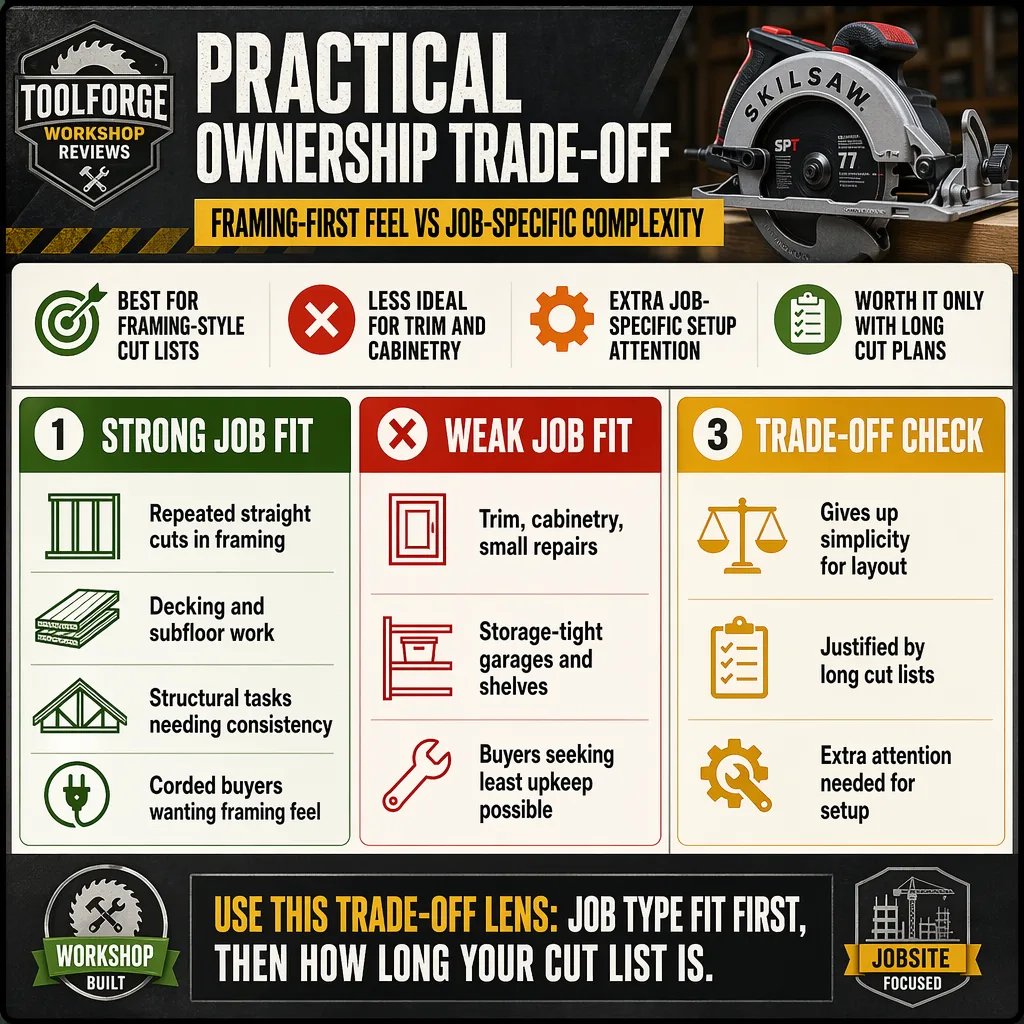
Strong fit
- Repeated straight cuts in framing lumber
- Decking, subfloor, and other structural work
- Buyers who want a corded tool with a more serious framing feel
Weak fit
- Trim, cabinetry, and small repair jobs
- Storage-tight garages and shelves
- Buyers who want the least upkeep possible
Trade-off The saw gives up some simplicity in exchange for a more job-specific layout. That trade pays off only when the cut list is long enough to justify the extra attention.
What matters most The best circular saw for most buyers stays a basic sidewinder. This model makes sense when the work list rewards framing geometry, not when the goal is one easy saw for everything.
What We Checked
This analysis centers on the saw’s layout, the ownership tasks that layout creates, and how those tasks line up with the jobs buyers actually do. Motor claims matter less here than the tool’s fit with your cut line, your cord setup, and the maintenance you are willing to handle.
That matters because saws fail quietly for buyers. A tool that feels serious in the store frustrates owners later if it needs more storage space, more setup time, or more attention than the job list justifies. The practical question is not whether the model looks capable. It is whether the ownership burden matches the work.
Where It Makes Sense
Buy-this-if scenario
- You cut framing lumber, deck boards, or sheet goods often enough to justify a dedicated saw.
- You already own a general-purpose saw and want a stronger framing option.
- You accept corded power and the extra upkeep that comes with a worm-drive layout.
Best-fit scenario A homeowner or carpenter who wants one saw reserved for bigger cuts, while a lighter saw handles the rest.
Project-match matrix
| Project | Fit | Why |
|---|---|---|
| Wall framing | Strong fit | Repeated straight cuts reward a framing-oriented layout |
| Decking and subfloor | Strong fit | Long cuts and stable guidance matter more than compact size |
| Plywood and OSB | Good fit | Line tracking matters more than convenience |
| Trim and cabinets | Weak fit | The tool is more saw than the task needs |
| One-off repairs | Weak fit | Setup burden outweighs the gain |
Safety and setup quick tips
- Start with a fresh blade matched to the material.
- Set depth and bevel before the cut begins.
- Support both sides of sheet goods before the blade exits.
- Match the extension cord to the run length.
- Wear hearing and eye protection every time.
- If you buy used, inspect the guard, shoe, and cord before you pay.
The ownership burden here is simple to read. A framing saw earns shelf space only when it sees regular use. If it comes out twice a year, the cord, the storage footprint, and the extra attention feel heavier than the saw itself.
The First Filter for Skill Saw
Most guides start with power numbers. That is the wrong first filter for this model. The first question is whether a left-blade worm-drive layout fits the way you see the cut, brace the material, and manage the cord.
For right-handed users who want more of the cut line in view, the layout pays off fast. For buyers who want a saw that disappears into a cabinet or truck bin and asks for very little thought, the layout adds friction instead of value.
First filter questions
- Do you cut framing and sheet goods more than occasional trim?
- Do you want the blade side in view while you track the line?
- Do you already accept corded-tool discipline?
- Do you want a saw that rewards maintenance, not one that ignores it?
Most people shopping for the best circular saw for most jobs land on a simpler sidewinder. That is not a downgrade. It is the better answer when storage, setup, and low annoyance matter more than a framing-specific feel.
What to Verify Before Buying
The useful checks sit outside the marketing copy.
- Confirm the blade orientation fits your stance and the way you guide cuts.
- Budget for a quality blade and the proper extension cord.
- If you plan to buy used, inspect the shoe, guard, cord, and housing first.
- If this is the worm-drive version, plan on oil checks as part of ownership.
- Treat a bent shoe or sticky guard as a real problem, not a cosmetic one.
A common misconception says a tougher-looking saw is automatically the better purchase. That is wrong. Extra weight and a more serious layout help only when the job uses them. For light-duty household work, the best light-duty saw is a simpler sidewinder, because it stays easier to carry, easier to store, and easier to hand off.
Secondhand listings deserve a strict look. A clean cord and a straight shoe tell you more than a dusty case. On older framing saws, wear shows up in the parts that touch the cut before it shows up in the motor.
How It Compares With Alternatives
Best Circular Saws of 2026 context: this model belongs in the framing-first group, not the easiest all-purpose group.
The best circular saw for most buyers is still a basic sidewinder. That choice removes setup friction and upkeep without giving up much on trim, repairs, or weekend projects.
| Option | Best for | Trade-off |
|---|---|---|
| skill saw, Skil SPT77WML-01 | Framing, long straight cuts, users who want a worm-drive feel | More upkeep, more cord discipline, larger storage burden |
| Basic sidewinder | Trim, repairs, occasional household work | Less framing-focused feel and less line-visibility advantage |
| Cordless rear-handle saw | Remote jobs, roof work, punch-list mobility | Battery cost, charging routine, and pack weight |
Choose this Skil when the job list is structural or repetitive. Choose a sidewinder when the saw spends more time on a shelf than on lumber. Choose cordless when outlet access shapes the job instead of the cut.
Fit Checklist
- You cut framing lumber, decking, or sheet goods often enough to justify a dedicated saw.
- You already own or plan to buy a quality blade and the right extension cord.
- You want a left-blade worm-drive layout.
- You accept oil checks and a larger storage footprint.
- You want a corded tool, not battery management.
Three or more yes answers point to a fit. Two or more no answers point to a simpler sidewinder.
Final Verdict
Buy the skill saw if your work is framing-heavy, your cuts are long and straight, and you want a worm-drive layout that feels more capable than a basic homeowner saw. Skip it if your jobs stay light, your storage is tight, or you want the best light-duty saw for quick household fixes.
The practical recommendation is direct: choose this model for work that deserves a dedicated framing saw, and choose a basic sidewinder for everything else. That is the better value for most buyers because the simpler tool removes upkeep without giving up much on casual jobs.
FAQ
Is the Skil SPT77WML-01 too much saw for casual home projects?
Yes. It belongs in framing, decking, and repeated straight-cut work, not in one-off shelf installs or picture-hanging duty.
Does a worm-drive saw need more upkeep than a sidewinder?
Yes. Oil checks and a little more storage discipline belong to worm-drive ownership, while a sidewinder skips that step.
Why do buyers pick a left-blade saw?
A left-blade layout keeps more of the cut line in view for many right-handed users and makes longer cuts easier to track.
Should this be your first circular saw?
Only if your first jobs are framing or other demanding cuts. For general household use, a basic sidewinder makes more sense.
What should I inspect if I buy one used?
Check the shoe, guard, cord, and housing first. Straight parts and clean movement matter more than cosmetic wear.