
The Short Answer
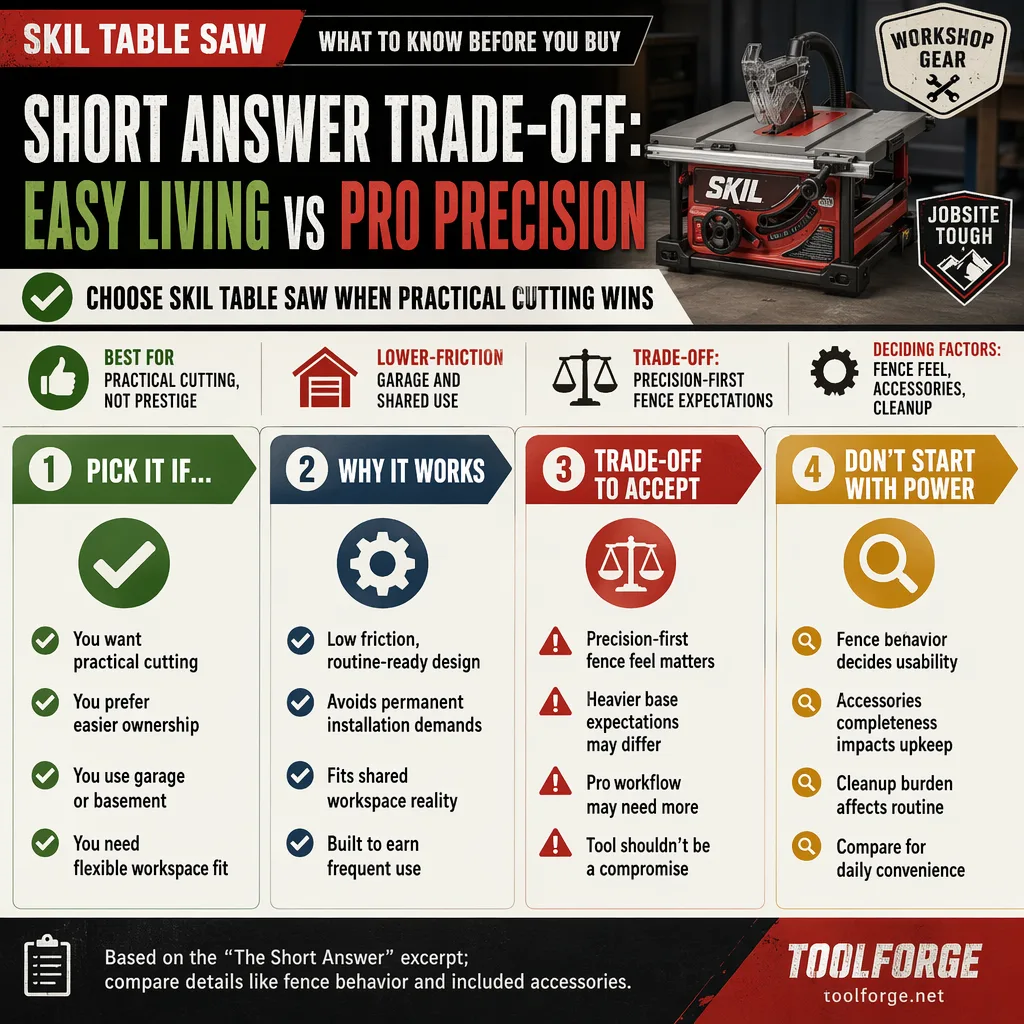
Skil belongs on the shortlist when the goal is practical cutting, not tool-room prestige. It fits buyers who want a table saw that feels easier to live with than a bigger stationary machine.
Best Table Saw is the Skil Table Saw: Tool Review
That claim makes sense for a buyer who wants a usable saw with lower friction, not a heavy-duty shop anchor.
Top-Line Skil Table Saw Review
The main appeal is simple: this is the kind of saw that earns its keep in a garage, basement, or shared workspace without asking for a permanent installation plan. The trade-off is just as clear. Buyers who want a precision-first fence feel, a heavier base, or a tool that disappears into a pro workflow should keep comparing.
A common mistake is to start with raw power talk. That is wrong here because fence behavior, accessory completeness, and cleanup burden decide whether a table saw becomes part of the routine or a nuisance that gets avoided.
Best fit
- Weekend projects and remodel cuts
- Garage shops with limited space
- Buyers who want a simpler saw to own and store
Not the best fit
- Daily production work
- Buyers who want cabinet-saw steadiness
- Shops that demand the cleanest possible dust control
What We Evaluated It On
This analysis uses the product category’s practical buying factors, grounded in documented research and buyer-fit criteria. The question is not whether the saw sounds impressive on paper. The question is whether it lowers the hassle of cutting wood in a real shop, where storage, cleanup, and setup time matter just as much as the cut itself.
Most guides start with motor language and blade talk. That is the wrong order for this purchase. The parts that shape ownership are the fence, the included accessories, how the saw stores, and how much dust it throws into the room.
The buyer-fit logic is straightforward:
- If the saw lives in a garage and comes out for projects, simplicity matters.
- If the saw must share space with cars, storage bins, or lawn gear, footprint matters.
- If the saw will be used for repeatable joinery, fence quality and reset ease matter more than a flashy spec line.
This is the real deal for a purchase decision, not a Real Deal, Hands-On Skil Table Saw Review. The point is to reduce regret before the box gets opened.
Where It Makes Sense
Skil makes the most sense for buyers who want a table saw that supports ordinary work without creating a second hobby around maintenance. A small shop, a one-car garage, or a mixed-use basement fits that profile.
Best-fit scenario box
Best fit: a homeowner cutting trim, framing lumber, shelving, or the occasional plywood panel in a space that needs to stay tidy.
Not a fit: a production-heavy shop, a precision-first furniture workflow, or a buyer who wants the saw to feel like a permanent industrial fixture.
The ownership burden stays lower when the saw is used for clear, repeatable jobs. The burden rises when the buyer expects one tool to handle everything from rough construction lumber to exacting cabinet parts. That is where disappointment starts.
The Skil table saw also suits first-time table saw buyers who want a lower-stress entry point. It is easier to justify when the priority is learning the workflow and keeping the shop manageable. It is a weaker fit for the buyer who already knows they want a higher-end portable saw or a more rigid stationary setup.
What to Verify Before Buying
This is the section that saves money. The exact listing matters more than the brand name because table saw bundles vary, and the annoying parts live in the details.
Watch the Skil table saw review checklist, not the marketing headline:
- Confirm what comes in the box: fence, miter gauge, blade guard, riving knife, push stick, and stand if needed.
- Check how the fence stores and locks.
- Confirm blade compatibility and replacement availability for the exact version you are considering.
- Measure where the saw will live, then measure the space it needs for infeed, outfeed, and storage.
- Look closely at dust management if the saw shares space with a car, laundry area, or finished flooring.
- Verify whether the layout supports quick setup, because slow setup kills weekend use.
The main trade-off is plain. Portable and compact saws ask for more attention to cleanup and staging than heavier shop saws. Buyers who hate sweeping sawdust or moving support stands should not treat that as a minor detail.
The First Filter for Skil Table Saw
The first filter is not cut capacity. It is where the saw lives when it is not in use.
If the saw rolls out of storage, cuts in place, and returns to a corner, Skil fits the job. If the saw has to pass through a narrow doorway, fit beside parked vehicles, or share space with holiday storage, the ownership burden grows fast. That burden shows up as extra lifting, extra clearing, and extra time before every cut.
The other filter is cleanup. A saw that leaves more debris in a shared room creates friction after the work is done, not just during it. Buyers who only look at the cut ignore the part that decides whether the tool stays pleasant to own.
That is the scenario where regret shows up first: the saw works, but the room becomes harder to use.
How It Compares With Alternatives
Then there was the Bosch table saw that was the best table saw for a while, and it still belongs in the comparison set for buyers who care about portable-saw refinement. Bosch frames the choice differently. Skil leans into practical ownership and a simpler buy. Bosch serves the buyer who values a more polished portable-saw benchmark.
| Option | Best for | Main trade-off |
|---|---|---|
| Skil table saw | Garage shops, weekend projects, simpler ownership | Less reason to buy if you want premium polish or daily production duty |
| Bosch table saw | Buyers who want the benchmark portable-saw comparison | More of the decision depends on whether the extra refinement matters to the workflow |
| Larger stationary saw | Dedicated shops and frequent ripping | Bigger footprint and more installation burden |
Choose Skil if the saw needs to be easy to store, easy to set up, and easy to live with. Do not choose it if the job demands a more rigid shop anchor.
Choose Bosch if the comparison centers on portable-saw refinement and you want to compare against the familiar benchmark. Do not choose Bosch just because it sounds more premium on paper.
If the saw will stay planted in a dedicated shop and get used often, the better comparison shifts toward a larger stationary saw instead of either portable option.
Decision Checklist
Use this quick check before buying:
- You have a garage, basement, or shared space that needs a manageable saw.
- You want low-friction setup more than maximum precision.
- You accept regular dust cleanup as part of ownership.
- The exact listing clearly shows the accessories you need.
- You do not expect cabinet-saw steadiness or production-level duty.
If three or more of those are true, Skil fits the purchase. If the main reason to buy is precision bragging rights, keep looking.
Final Verdict
Skil deserves a recommendation for homeowners, remodel-minded buyers, and weekend woodworkers who want a table saw that supports real projects without a heavy ownership tax. It also works for buyers who value easy storage and a simpler setup routine.
Skip it if your work leans toward repeatable fine joinery, heavy production use, or a shop where a more rigid and polished machine earns its keep. The right call here is not about impressiveness. It is about whether the saw gets used without adding annoyance.
FAQ
Is the Skil table saw good for beginners?
Yes. It fits beginners who want to learn straight cuts, sheet-good breakdown, and basic project work without jumping straight into a more complex shop machine. It is the wrong first saw for buyers who expect cabinet-shop precision from day one.
What should I check before buying one?
Check the fence, blade guard, riving knife, miter gauge, stand, and dust setup for the exact listing. Also confirm storage space and blade compatibility. Those details decide whether the saw feels organized or frustrating.
How does the Skil table saw compare with Bosch?
Skil fits the buyer who wants a simpler ownership path and easier setup. Bosch belongs on the shortlist when the portable-saw benchmark matters more and you want a more polished comparison point.
Is this a good saw for a small garage shop?
Yes, if the garage has room for infeed, outfeed, and storage after the cut. It is a poor fit if every project starts with clearing half the room and ends with a long cleanup.
Should I skip Skil if I already own a contractor saw?
Yes, unless you need a smaller, easier-to-store backup saw. If you already own a heavier saw that stays in place and performs the work cleanly, Skil does not add much unless portability matters more than rigidity.