
Quick Buyer Summary
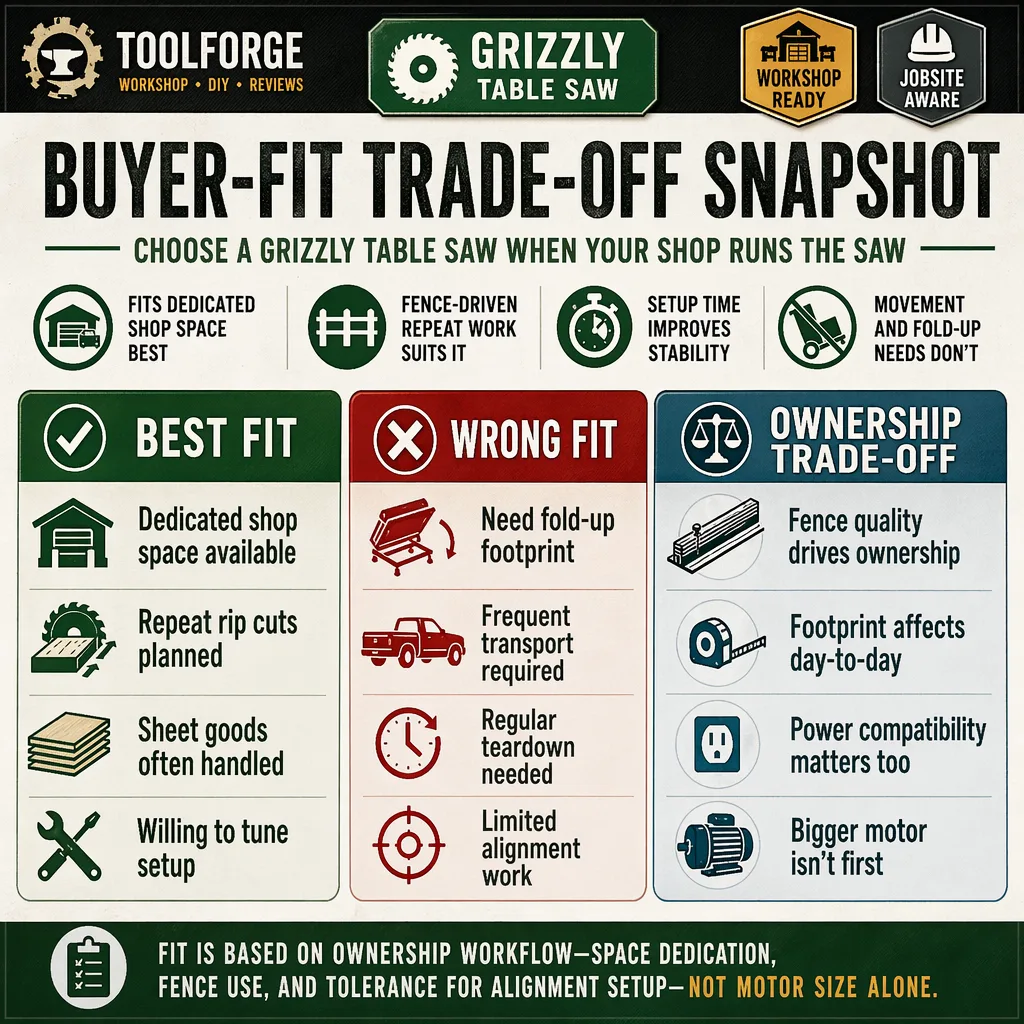
It is the wrong buy for anyone who wants a fold-up footprint, frequent transport, or the easiest possible first setup. Most guides recommend chasing motor size first, that is the wrong order because fence quality, footprint, and power compatibility shape ownership more than a bigger badge on the cabinet.
Best fit
- Dedicated shop space
- Repeat rip cuts and sheet goods
- Buyers willing to spend time on setup for better stability
Weak fit
- Shared garage or storage-heavy shop
- Frequent moving or teardown
- Minimal tolerance for alignment work
What We Checked
The purchase decision rests on four things: shop fit, alignment behavior, dust handling, and how much setup burden the saw asks for before the first cut. Motor label and rip number matter, but they sit behind the fence, the footprint, and the support system.
That order matters because table saws punish bad fit. A machine with decent cutting ability but awkward placement, touchy alignment, or poor dust control gets used less often than a simpler saw that stays easy to live with.
The First Filter for Grizzly Table Saw
Before comparing blade size or fence style, answer one question: does your shop support a stationary saw with enough room to feed and support stock safely? If the answer is no, this class of saw is a bad match, no matter how appealing the spec sheet looks.
This filter matters more than most buyers admit. A saw that can rip wide stock on paper still becomes frustrating if the fence rail steals walk space, the outfeed path runs into a wall, or the power setup needs changes you do not want to make.
The first things to verify
- Floor space with the fence extended
- Outlet type and circuit capacity
- Outfeed and infeed clearance
- Dust collection path
- Whether a mobile base is part of the plan or just a rescue option
Where It Makes Sense
A Grizzly table saw belongs in a shop that has already accepted a more permanent layout. It fits woodworkers who cut cabinet parts, plywood, and repeat rip cuts often enough that steadiness matters more than portability.
It also fits buyers who want a heavier, less fussy platform than a bargain portable saw. The trade-off is simple: you get a more planted machine, and you give up the easy storage and quick teardown that make smaller saws so convenient.
| Scenario | Fit | Why it works | Watch-out |
|---|---|---|---|
| Dedicated garage shop | Strong | The saw can stay put, and the extra stability pays off on repeat cuts. | Still measure for infeed, outfeed, and sheet handling. |
| Basement workshop | Conditional | Good if the space stays organized and the saw has a clear operating zone. | Stairs, doors, and low ceilings make moving and assembly harder. |
| Shared garage | Poor | Only works if a fixed corner stays open all the time. | Vehicle storage and daily cleanup erase the advantage of a bigger saw. |
| Used-tool buyer who inspects carefully | Strong | Good value exists when the fence, arbor, and guards are complete and square. | Missing parts and sloppy alignment erase the savings fast. |
A good use case for this saw is a buyer who wants to build a real shop station, then leave it alone. A bad use case is someone who wants one machine to serve as both a shop saw and a space saver.
Where It May Disappoint
The main trade-off is not raw cutting power. It is the amount of attention the saw demands around setup, space, and cleanup.
Power and rip capacity trade-offs
Rip capacity gets too much credit in most buying guides. That is wrong because extra width only helps when the fence stays accurate and the shop has room to support the stock. A wider setup that crowds the room or makes sheet handling awkward creates more annoyance than value.
A bigger motor also does not fix a bad fit. If the saw has to run on an electrical setup that does not match the model, or if the shop layout leaves no room for outfeed support, the extra capacity turns into unused potential. The better question is not, “How much can it cut?” It is, “How smoothly does it fit the cuts I actually make?”
Accuracy, fence, and build quality
Fence quality matters more than headline power for most buyers. A fence that locks square and stays there makes repeat cuts easier, reduces measuring loops, and lowers the chance of drifting cuts that need cleanup later.
A sturdier body helps with stability, but it does not rescue a weak fence or sloppy alignment. Buyers who want less frustration should inspect how the fence clamps, how smoothly adjustments move, and whether the blade tracks cleanly with the miter slots. If the fence feels vague, the saw becomes a measuring machine instead of a cutting machine.
Dust collection, noise, and safety
Dust collection is part of the ownership cost, not an optional extra. Without a plan for chips and dust, cleanup gets longer, visibility drops, and the saw area turns annoying faster than it should.
Noise stays part of the deal as well. A heavier saw does not become quiet just because it is more substantial. Safety gear matters here too, especially the guard, riving knife, and anti-kickback parts on a used unit.
Assembly, setup, and new vs used
Even a new saw needs alignment time. Buyers who want plug-and-play convenience are shopping in the wrong class.
A used Grizzly table saw deserves a hard inspection. Check the fence lockup, the arbor for smooth spin, the table surface for rust or gouges, the tilt and height mechanisms for smooth travel, and the presence of the guard, insert, and riving knife. A cheap used saw with missing parts turns into a parts hunt, and that erases the savings quickly.
Common mistakes
- Buying for motor size before checking fence quality
- Forgetting outfeed space for plywood and long boards
- Assuming a used saw includes all guards and inserts
- Ignoring the circuit or outlet type until delivery day
How It Compares With Alternatives
Against a jobsite saw, Grizzly gives up portability and easy storage. It wins on planted feel, support for larger stock, and the sense that the saw belongs in one spot and stays there.
Against a cabinet saw, Grizzly sits in the middle. A cabinet saw belongs in a shop that already has the space, dust collection, and permanent layout to justify a heavier machine. Grizzly makes more sense when you want serious shop capability without jumping straight to the most committed stationary category.
When a jobsite saw wins
Pick a jobsite saw if the saw needs to roll out, fold up, or travel. It fits punch-list work, light remodeling, and shops that do not want a permanent footprint.
When a cabinet saw wins
Pick a cabinet saw if the workspace is already built around a fixed machine and you want the more serious long-term shop layout. It suits buyers who treat the saw as the center of the shop, not one tool among many.
When Grizzly sits in the middle
Grizzly fits the buyer who wants a real shop saw without the heaviest ownership burden. That is the sweet spot for many home shops, but only if the space, power, and dust setup already support it.
Pre-Buy Checks
Use this checklist before you commit:
- The saw will live in one place, not move every session.
- Your outlet and circuit match the model you are considering.
- You have room for infeed, outfeed, and fence travel.
- The fence locks firmly and stays square.
- Dust collection is planned, even if it starts simple.
- If buying used, the guard, riving knife, insert, and fence parts are present.
- You are comfortable spending setup time on alignment before the first real project.
If two or more of those boxes are blank, a lighter saw class fits better.
Bottom Line
A Grizzly table saw is a smart buy for a stationary shop that values stability, support, and repeatable cuts more than portability. It is not the right buy for anyone chasing quick storage, minimal setup, or the easiest possible first-cut experience.
Buy it if your saw will stay in a dedicated shop and you want a more planted cutting station. Skip it if the machine needs to fold away, move often, or run on a constrained electrical setup. For the right buyer, the fence, footprint, and power fit matter more than any headline number.
FAQ
Is a Grizzly table saw good for a small garage shop?
Yes, if the garage stays dedicated to woodworking and you have room for infeed and outfeed. It is a poor fit when the garage also needs to hold cars, storage, or a lot of cleanup gear.
Should I buy Grizzly new or used?
Buy new if you want less risk and a cleaner starting point. Buy used only after checking the fence, arbor, top surface, safety parts, and all adjustment mechanisms, because missing pieces turn the deal into extra cost.
What matters more, the fence or the motor?
The fence matters more for most buyers. A strong fence keeps cuts repeatable and reduces setup friction, while a bigger motor only helps when the stock demands more cutting capacity.
Do I need dust collection with this saw?
Yes, if you want the saw to stay pleasant to use. Without dust collection, cleanup gets slower, visibility drops, and the shop floor gets messier around the blade area.
Is this a better buy than a portable jobsite saw?
It is the better buy for a fixed shop that values stability and repeat cuts. A portable jobsite saw wins when storage, mobility, or quick teardown matters more than a planted cutting station.