
How This Page Was Built
- Evidence level: Structured product research.
- This page is based on structured product specifications and listing details available at the time of writing.
- Manufacturer documentation, specifications, retailer details, and buyer-fit context were reviewed for this page.
- Use it to judge buyer fit, trade-offs, and purchase criteria rather than lab-style performance claims.
What Matters Most Up Front
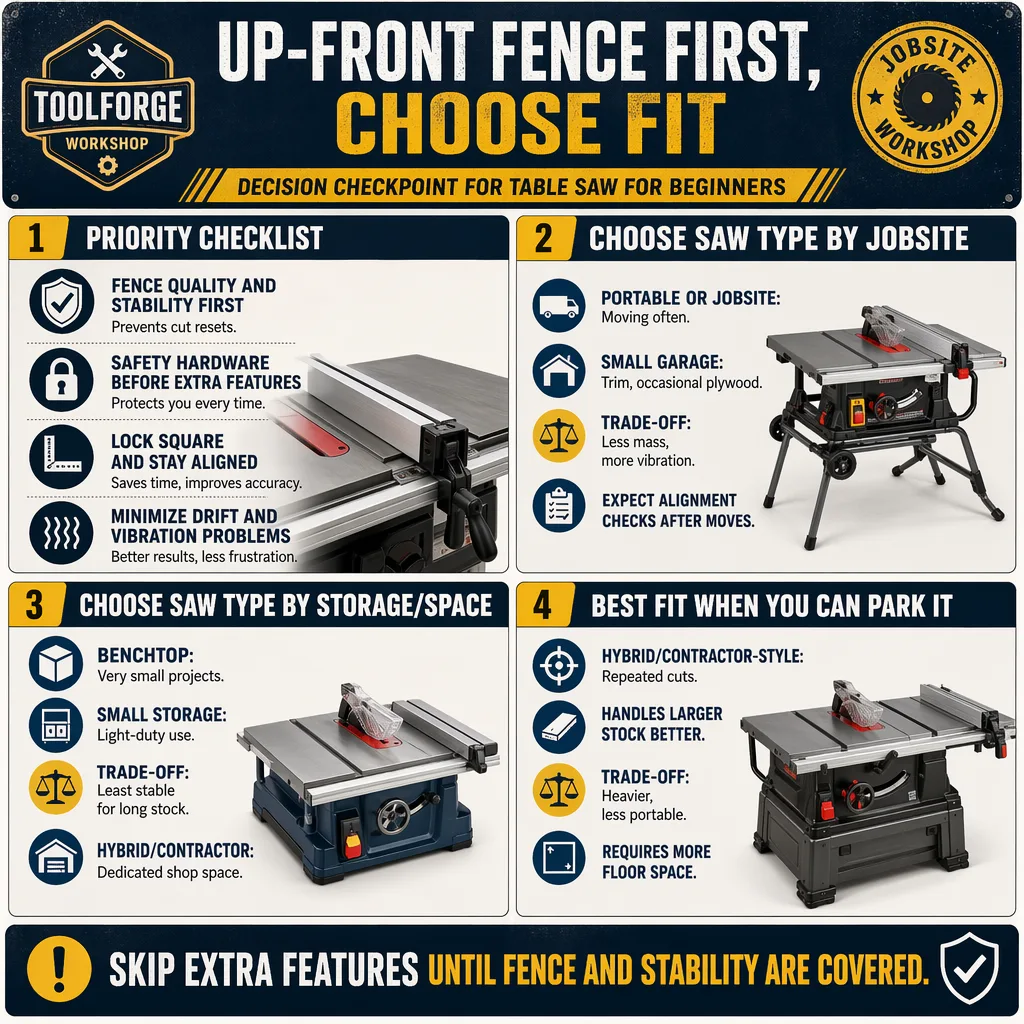
| Saw type | Best fit | Main trade-off | Beginner fit |
|---|---|---|---|
| Portable or jobsite | Small garage shops, moving between spaces, trim work, occasional plywood | Less mass, more vibration, more alignment checking after moves | Strong fit if storage and mobility matter most |
| Benchtop | Very small projects, short storage, light-duty use | Least stable, smallest table support, highest annoyance on long stock | Only fits narrow needs |
| Hybrid or contractor-style | Dedicated shop space, repeated cuts, larger stock | Heavier, harder to move, demands more floor space | Best when the saw stays parked |
How to Compare Your Options
Compare the saw by the cuts you plan to make, not by headline power. A beginner gets more from a predictable fence and a clean setup path than from a bigger motor that sits behind a sloppy table.
Fence and table stability
A fence that flexes with hand pressure ruins repeatability. Press stock against the fence, and if the fence moves or the lock feels vague, the saw creates extra work after the first weekend.
Flat support matters just as much. A board that rocks or tips at the edge of the table starts binding before the blade even reaches the cut line. That turns small mistakes into burn marks, chatter, and more chance of a dangerous push.
Rip capacity and support
A 24-inch rip capacity handles a lot of beginner plywood work without awkward repositioning. A 12 to 18 inch saw suits trim, shelving, and smaller furniture parts. Anything below that feels cramped once the projects get wider than picture frames.
The number on the spec sheet does not solve sheet goods by itself. Long boards need infeed and outfeed support, so a 30-inch fence on a tiny open space still behaves like a compromise.
Safety parts that reinstall cleanly
A riving knife matters because it stays in line with the blade and helps reduce pinching. A blade guard matters only if it goes back on without a fight. If a safety piece turns into a storage problem, it stops being used.
That detail never looks dramatic on a product page. It shows up in the garage on the second or third setup, when convenience decides whether the guard stays attached.
Dust and cleanup
Dust around rails, gears, and the throat area adds friction to every adjustment. A saw that collects debris in awkward spots becomes harder to square and harder to keep smooth.
If cleanup takes longer than the cut list, the saw owns the shop. That is the opposite of beginner-friendly ownership.
What You Give Up Either Way
Portability and stability sit at opposite ends of the table saw decision. A lighter saw moves easily and stores easily, but it asks for more checks. A heavier saw cuts with less fuss, but it claims permanent floor space and a more deliberate setup.
Most guides tell beginners to buy the biggest saw they can fit. That is the wrong order because a saw that is annoying to set up gets used less, even if it has more capacity. The comparison point is not just size, it is repeatability.
A simpler alternative sharpens the decision. A circular saw with a straightedge handles breakdown work with very low storage burden. It gives up fast repeat rip cuts and compact joinery, but it wins when the table saw would spend more time being moved than used.
The First Filter for Table Saw For Beginner
Run the first five setup checks before you compare extra features or accessories. If two of these fail, keep looking.
- The base sits flat and stable. Rocking on the floor means alignment chores start immediately.
- The fence locks without deflection. Press on the fence and look for movement.
- The blade height and bevel controls move smoothly. Jerky controls waste time and frustrate accurate setup.
- The riving knife and guard reinstall without special drama. If the parts are awkward to return, they end up unused.
- The dust port and cord path do not block storage or folding. A messy setup path turns a small saw into a daily inconvenience.
A beginner does not need a perfect saw. A beginner needs a saw that squares up quickly and stays there.
Best-fit scenario A garage or basement shop, small furniture, shelf parts, trim cuts, and occasional plywood. The saw stays in one area, the workspace stays clear enough to support long boards, and the owner wants repeatable cuts more than maximum table size.
The Use-Case Map
Match the saw to the job mix, not the fantasy project list. The right choice changes fast once space, storage, and cleanup enter the picture.
- Trim, face frames, small boxes: A portable saw or even a benchtop saw works if the fence locks cleanly and the table stays steady.
- Shelving, bookcases, small cabinets: A portable saw with stronger support and at least 24 inches of rip capacity fits better.
- Frequent plywood work: A bigger rip range and an outfeed plan matter more than compact storage.
- Very tight spaces or no permanent station: A circular saw with a straightedge beats forcing a table saw into a closet workflow.
The first week tells the truth here. If moving the saw, clearing the path, and lining up support feels like a chore before every cut, the machine gets used less.
Routine Checks
Plan on alignment and cleaning as part of ownership. A beginner table saw does not need constant repair, but it does need repeat checks after moves and regular cleanup around the moving parts.
Keep these on a short loop
- Brush dust from the fence rails, miter slot, and elevation gears.
- Recheck blade-to-fence and blade-to-miter-slot alignment after the saw moves.
- Clean pitch from the blade when cuts start burning or feeding harder.
- Keep one general-purpose blade ready and use a finer blade for cleaner work.
- Store wrenches, guards, and inserts in one place so safety parts stay reachable.
A dull blade creates more heat, more force, and rougher edges. Beginners blame the saw first, but a dull blade often causes the problem.
What to Verify Before Buying
Check compatibility before you check accessories. The wrong fit on the floor, outlet, or dust path creates more annoyance than a missing feature ever will.
- Footprint with the stand open and folded: Measure the path through doors and around corners, not just the parked footprint.
- Infeed and outfeed room: A saw that fits the floor but not the board length still wastes time.
- Power access: Keep the saw on a circuit that does not share a crowded load with other tools.
- Dust hookup: Make sure the port and hose path match your shop vac or collector plan.
- Accessory standardness: Common blades, inserts, and gauges are easier to replace than obscure proprietary pieces.
- Used-saw completeness: Missing guards, fences, or throat plates turn a bargain into a scavenger hunt.
This is where secondhand shopping gets tricky. A low-use saw with missing parts often creates more setup friction than a newer basic model with everything included.
When Another Option Makes More Sense
Skip the table saw if the job is mostly breakdown work, if the workspace changes every session, or if the saw lives in storage more than it lives in use. A circular saw with a straightedge handles those cases with less setup burden and less floor commitment.
A miter saw fits repeat angle cuts, trim, and crosscuts better than a table saw in many small shops. It solves a different problem, and it does that problem with fewer alignment demands.
A table saw also loses the argument when no safe infeed or outfeed space exists. Crowding the cut area raises annoyance and risk at the same time.
Final Buying Checklist
Use this as the last pass before purchase.
- I need repeat rip cuts, not only rough breakdown.
- I have at least 24 inches of rip capacity if plywood matters.
- The fence locks square and stays put.
- The stand or base sits stable on my floor.
- The guard and riving knife go back on without a struggle.
- I have a dust plan that fits my shop vac or collector.
- I have infeed and outfeed space for my longest common board.
- I know where the saw will live between projects.
- I am willing to recheck alignment after moves.
If three or more boxes are no, choose the simpler tool path for now.
Common Mistakes to Avoid
Most beginner mistakes come from ignoring the work around the cut. The saw itself is only part of the ownership cost.
Common mistakes that cost you later
- Buying by motor size before checking fence quality
- Measuring the saw body and forgetting board support
- Choosing a compact saw and expecting it to feel simple
- Skipping blade quality and blaming the machine for burn marks
- Leaving safety parts off because they slow setup
Most guides push power first. That is wrong because fence repeatability, stability, and cleanup shape daily use more than cutting force does.
A smaller saw with a sharp blade and solid fence gives a better beginner experience than a bigger saw with slop and drift. The first one gets used. The second one gets tolerated.
The Practical Answer
A table saw for beginners fits best when the saw stays in one place, the fence locks reliably, and the projects call for repeatable cuts. Choose a portable saw if storage and movement matter. Choose a heavier saw if the shop has permanent space and the saw stays set up.
Skip the table saw if your work is mostly sheet-good breakdown, your space is tight, or you know the saw will spend more time stored than cutting. In that case, a circular saw with a straightedge keeps ownership simpler.
The safest beginner purchase is not the biggest saw. It is the simplest saw that matches the projects, the space, and the amount of setup you will actually accept.
Frequently Asked Questions
What rip capacity does a beginner need?
A 24-inch rip capacity handles a lot of beginner plywood work and shelf parts. A 12 to 18 inch saw fits trim, small furniture, and narrow stock. Less than 20 inches feels limiting fast once sheet goods enter the plan.
Is a portable table saw good enough for a beginner?
Yes, if the stand is stable and the fence locks square. The trade-off is more vibration and more alignment checking after moves. That is a fair trade when storage and mobility matter.
Do I need a blade guard and riving knife?
Yes. The riving knife helps keep the kerf from pinching, and the guard adds protection when it stays easy to reinstall. A safety part that lives in a drawer does not help.
Should I buy a table saw or a circular saw first?
Buy a circular saw first if you break down sheets, work in tight space, or move the tool often. Buy a table saw first if you need repeatable rips and small-part accuracy more than portability.
What should I inspect on a used table saw?
Check the fence lock, blade alignment, arbor play, guard pieces, miter gauge fit, and missing hardware. A used saw with missing parts or a poor fence looks cheaper than it acts.
What matters more, motor power or fence quality?
Fence quality matters more. A beginner notices repeatability, setup time, and straight cuts before motor strain shows up. A strong motor does not fix a weak fence.
How much maintenance does a beginner table saw need?
It needs regular dust cleaning, alignment checks after moves, and blade care. That upkeep keeps the saw smooth and keeps the cuts predictable.