
How This Page Was Built
- Evidence level: Structured product research.
- This page is based on structured product specifications and listing details available at the time of writing.
- Manufacturer documentation, specifications, retailer details, and buyer-fit context were reviewed for this page.
- Use it to judge buyer fit, trade-offs, and purchase criteria rather than lab-style performance claims.
What Matters Most Up Front
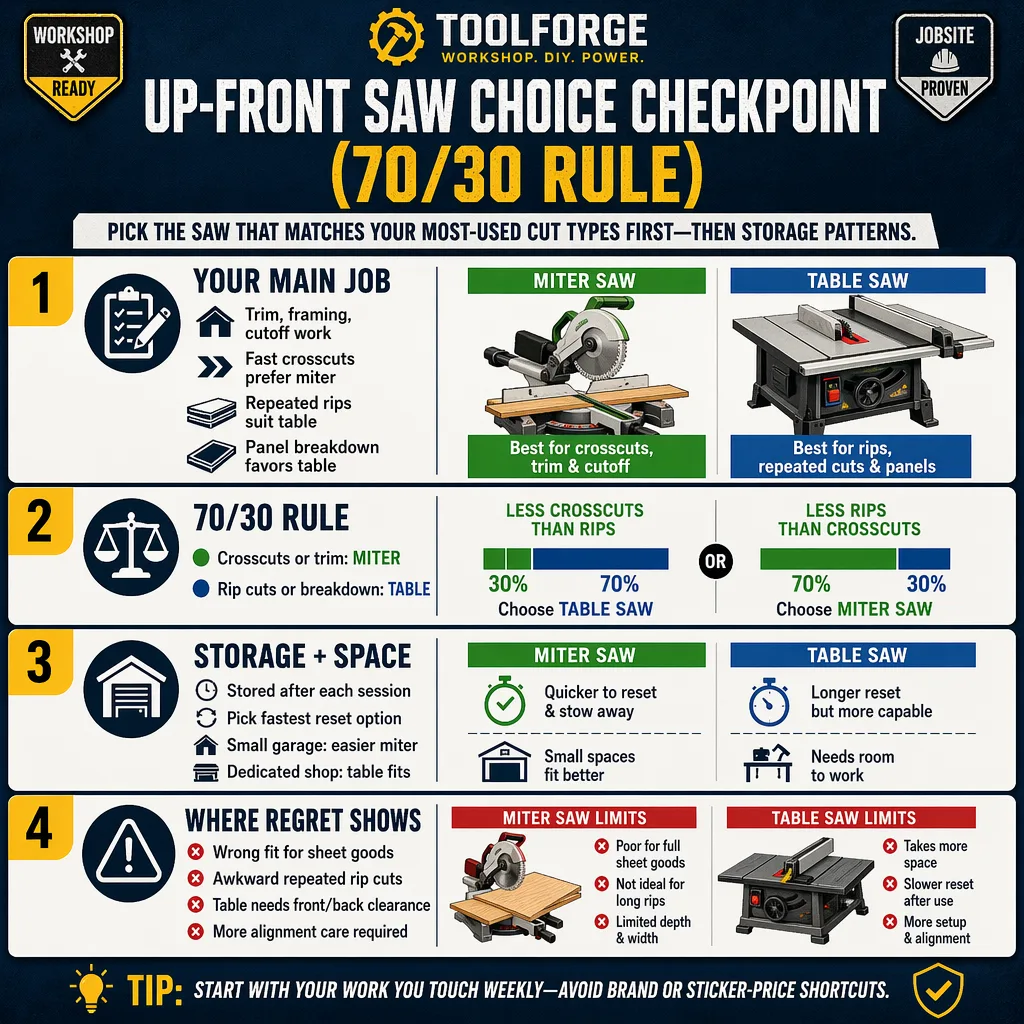
| Your main job | First pick | Why this fit works | Where regret shows up |
|---|---|---|---|
| Trim, framing, cutoff work | Miter saw | Fast crosscuts, easy setup, less floor demand | Wide sheet goods and repeated rip cuts stay awkward |
| Cabinets, shelving, plywood | Table saw | Repeatable widths and straight rip cuts | Needs front and back clearance, plus more alignment care |
| Small garage, shared room | Miter saw | Stores easier and resets faster after each use | Panel work still needs another method |
| Dedicated shop, fixed bench | Table saw | Stays ready for repeat width work and joinery parts | Less friendly for quick on-the-fly cuts |
Use a 70/30 rule of thumb: if 70% or more of your cuts are crosscuts or trim, start with the miter saw. If 70% or more are rip cuts or panel breakdown, start with the table saw. If the saw gets stored after each session, choose the one that resets fastest.
How to Compare Your Options
Compare the stock path first, then the cut list, then the accessory stack. A saw that looks more versatile on paper loses fast if it asks for the wrong kind of movement.
Crosscuts and trim work
A miter saw owns this job. The board stays supported, the cut line stays obvious, and setup stays short. That matters for baseboard, casing, framing lumber, and any cutoff pile where the goal is fast, repeatable length.
Rip cuts and plywood
A table saw owns this job. The fence sets width once, and every board follows it. That matters for shelving, cabinet sides, face frames, and plywood breakdown. A miter saw does not solve this work cleanly, and buyers who expect it to handle ripping end up fighting the tool.
Repeat length versus repeat width
This is the distinction that saves the most regret. A miter saw repeats length well. A table saw repeats width well. Finish carpentry rewards repeat length. Furniture and cabinet parts reward repeat width. Compound trim angles belong on the miter saw because the stock motion stays simpler, not because the table saw lacks accuracy.
Best-fit scenario box
- Small garage, trim and repair work: miter saw first
- Cabinet and shelving bench: table saw first
- Mixed DIY with little floor space: miter saw first unless plywood is routine
- Dedicated shop with feed room front and back: table saw first
What You Give Up Either Way
Accept the trade-off before you buy. A miter saw gives up ripping efficiency and sheet-goods convenience. A table saw gives up easy storage and fast repositioning.
Trade-off block Miter saws reduce setup friction. They add limits on board width and panel work. Table saws increase cut capability for widths. They add space demand, alignment care, and more attention at the blade.
The first week exposes these costs. Long boards need support. Dust lands farther than expected. A saw that needs a fence check before every project turns a quick repair into a calibration routine. The real budget drain is the saw that sits unused because the setup feels like a chore.
Safety follows the same pattern. Table saw work demands a controlled feed path and a clear offcut route. Miter saw work demands clamping and enough support for long stock, plus care with short offcuts near the blade.
The First Filter for Mitre Saw Or Table Saw
The first filter is where the board travels, not what the blade promises. If your cut station lives against a wall or along a bench, a miter saw fits the layout because stock spreads left and right. If your shop has a clear lane in front of and behind the saw, a table saw fits because the material moves straight through.
Small-space buying path
Small-space buyers should start with the miter saw when the room doubles as parking, storage, or laundry space. That setup keeps the work zone shallow and lets the saw disappear between projects. A table saw in the same room turns every cut into a room-rearranging event.
Mixed-project buying path
Mixed-project buyers should sort the mix honestly. If the mix is trim plus repairs, the miter saw comes first. If the mix is cabinets plus shelving, the table saw comes first. If the mix is one plywood project every few months, a circular saw with a straightedge handles the panel breakdown with less footprint than a table saw and less setup than a full station.
Dedicated-shop buying path
Dedicated-shop buyers get more value from the table saw when the bench area stays fixed and the infeed-outfeed lane stays clear. In that layout, the fence becomes a repeatability tool instead of an obstacle, and width control pays off on almost every project.
Upkeep to Plan For
Plan for upkeep as part of the purchase. Table saws reward alignment discipline. Miter saws reward square stops and clean support surfaces.
- Table saw upkeep: clean the top, recheck fence parallelism after moving the saw, keep the blade clean, and clear dust around the blade opening and arbor area. Fence drift shows up on every rip cut, so a little maintenance protects every project after it.
- Miter saw upkeep: confirm fence squareness, check miter detents and bevel stops, keep slide rails and pivot points clean if the saw slides, and replace the blade when finish cuts start tearing instead of slicing. Trim work exposes small setup errors fast.
- Shared rule: if the saw moves, square-check it before the first precise cut.
A stationary table saw stays predictable. A table saw that gets rolled around a garage needs more square checks. The same is true for a miter saw that lives on a folding stand.
Compatibility and Setup Limits
Measure the work envelope before you measure the price tag. The saw body matters, but the stock around it matters more.
- Long boards on a miter saw need side support. If the bench ends right at the saw, the cut turns into a balancing act.
- Plywood on a table saw needs clear infeed and outfeed room. A short aisle turns ripping into a shuffle.
- Small shops need stored and deployed footprints measured separately. A folding stand and a parked saw are two different sizes.
- Dust collection matters more on a table saw because rip work creates a long stream of debris, not a short burst.
- If you want a mobile base, test the path through doors and around parked vehicles. A rolling stand that binds in the garage eliminates the convenience you expect.
- Do not choose by blade size alone. Blade diameter does not solve support space, stock travel, or cleanup burden.
Most guides fixate on specs first. That is the wrong order because a saw only stays useful if the room and the workflow match the cut type.
When Another Option Makes More Sense
Some buyers should skip one saw as the first purchase.
Skip a table saw first if…
Skip a table saw first if the shop is temporary, shared, or too narrow for front-to-back feed room. In that setup, a table saw becomes a setup project instead of a shortcut. The saw only earns its footprint when it stays ready.
Skip a miter saw first if…
Skip a miter saw first if your projects start with plywood, shelving, or cabinet carcasses. A miter saw does not remove the need for straight rip cuts, and it does not speed up panel breakdown the way a table saw does.
Use a circular saw and straightedge instead if…
Use a circular saw and straightedge instead if you break down sheet goods a few times a year and do not need repeated width cuts. That route handles occasional panel work with less storage burden than a table saw and less bench length than a miter station. It gives up repeatable width control, which is fine when the work is infrequent.
Final Buying Checklist
Before you buy, answer these questions in order.
- Do most of your cuts run across boards or along them?
- Where does the stock travel, and does the room give it space?
- Do you need repeat length or repeat width more?
- Will the saw stay fixed or move often?
- How much cleanup and alignment work do you accept?
- Does another tool already cover the job the saw misses?
If the first three answers point the same way, the purchase is clear. If they point in different directions, buy for the job you do most often, not the one you hope to do someday.
Common Misreads
Do not choose by brand or price alone. Those labels do not tell you whether the fence stays square, whether the stock support fits your room, or whether the cleanup burden feels tolerable after the first week.
- “The biggest saw is the best starter.” Wrong. Oversizing the tool for the wrong job creates more storage friction and more setup time.
- “The cheapest saw is good enough.” Wrong if the fence, stand, or support layout adds annoyance every time you use it.
- “A table saw replaces a miter saw.” Wrong. Trim work, cutoff jobs, and angled finish cuts stay easier on a miter saw.
- “A miter saw is only for beginners.” Wrong. Finish carpentry and quick repair work live there long after the beginner phase.
- “Safety depends on the guard alone.” Wrong. Stock support, feed path, and a clear cut line do more to control the cut.
Decision Recap
Choose the saw that removes the most annoyance from the work you do most often.
- Miter saw first: trim, framing, short repeats, small shops, and easy storage.
- Table saw first: plywood, shelving, cabinet parts, repeated widths, and fixed workspaces.
- Neither first if panel work is rare: a circular saw with a straightedge handles occasional breakdown with less permanent footprint.
The practical answer is the tool that still feels easy after the first month, not the tool with the biggest capability list.
Frequently Asked Questions
Which saw should I buy first?
Buy the miter saw first if your work is trim, framing, or general repair. Buy the table saw first if your work is shelving, cabinetry, or repeated-width parts.
Can a table saw replace a miter saw?
No. A table saw handles some crosscuts, but it does not match a miter saw for fast cutoff work, long trim, or angled finish cuts.
What space check matters most before buying?
Measure stock travel, not just the saw footprint. Miter saws need side support. Table saws need clear infeed and outfeed lanes.
Is a sliding miter saw the answer for everything?
No. Sliding travel helps with wider crosscuts, but it does not solve ripping or sheet-goods workflow.
Should brand decide the choice?
No. Brand matters after the workflow fit is right. The saw type decides the work you can do, and the brand only changes the details around it.
Is a table saw safer than a miter saw?
No. Each saw has a different safety pattern. A table saw demands disciplined feed control and offcut handling. A miter saw demands stock support and careful clamping.
What if I only do a few plywood jobs a year?
Use a circular saw and straightedge for those jobs before you buy a table saw. That setup handles occasional sheet breakdown with less footprint and less upkeep.
What regret shows up fastest after the first week?
The fastest regret is buying the saw that does not fit the room. Setup friction, cleanup burden, and stock support problems show up before any long-term durability question does.