
Safety and Fit Boundary
How This Page Was Built
- Evidence level: Structured product research.
- This page is based on structured product specifications and listing details available at the time of writing.
- Manufacturer documentation, specifications, retailer details, and buyer-fit context were reviewed for this page.
- Use it to judge buyer fit, trade-offs, and purchase criteria rather than lab-style performance claims.
What Matters Most Up Front
Start with the cut type, not the tool size. Miter saws fit work where the board stays put and the blade comes down to the mark. Table saws fit work where the fence sets the width and the stock moves through the cut.
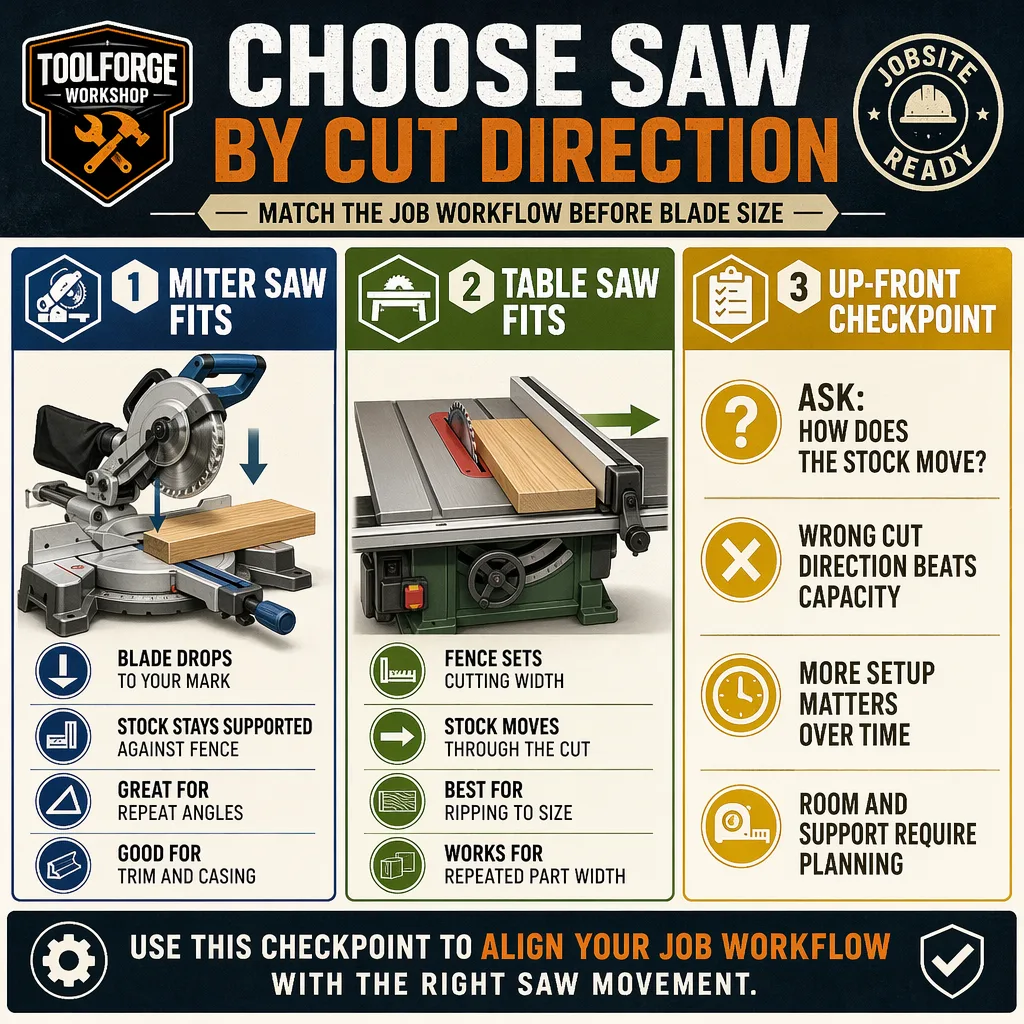
Choose a miter saw when the board stays long and the cut is short
A miter saw fits trim, casing, crown, framing, and repeated angle cuts because it removes setup steps from the workflow. The piece stays supported against the fence, and the cut happens fast. That matters when the same move gets repeated all day, because small setup delays turn into real annoyance.
Choose a table saw when width control matters more than angle speed
A table saw fits ripping boards to size, breaking down plywood, and making parts that need the same width again and again. It asks for more room, more fence care, and more attention to infeed and outfeed support. That burden pays back when straight-line accuracy matters more than speed at the cut line.
Most guides recommend the biggest blade or a sliding arm as the first decision. That is wrong because capacity does not fix the wrong cut direction.
Best-fit scenario box
- Miter saw first: trim, casing, crown, framing, jobsite work, compact storage.
- Table saw first: plywood, shelving, cabinet parts, repeatable widths, dedicated space.
- Neither first: rare cuts, tiny storage, no room for material support.
How to Compare Your Options
Use the comparison below to weigh annoyance cost, not just capability.
| Decision factor | Miter saw | Table saw | Buyer takeaway |
|---|---|---|---|
| Primary motion | Blade drops through stationary stock | Stock moves through a fixed blade | The motion decides the workflow more than the horsepower does. |
| Best material | Trim, framing lumber, angled cuts | Boards to width, panels, shelf parts | Use the saw that matches the material shape you handle most. |
| Setup burden | Lower for quick cuts and angle repeats | Higher because fence and blade alignment matter | Lower setup burden saves more time than extra capacity. |
| Space burden | Needs bench width and side support | Needs floor space plus infeed and outfeed room | Footprint alone does not tell the whole story. |
| Support burden | Long boards need wings or stands | Long boards and panels need feed support | Support errors are the fastest path to regret. |
| Repeat accuracy | Good for repeated angles and length cuts | Good for repeated widths and straight rips | Pick the repeat you need most. |
| Cleanup burden | Dust lands on the bench and behind the fence | Dust collects around the cabinet and floor | Cleanup changes ownership friction more than spec sheets admit. |
The most common regret is underestimating support, not buying the wrong blade diameter. A saw that forces a helper, a wall, or a clumsy board setup every time stops feeling simple very quickly.
What You Give Up Either Way
Every answer gives up one kind of convenience. A miter saw gives up ripping and panel breakdown. Sliding models add crosscut reach, but they do not make wide sheet goods easy.
A table saw gives up quick angle work and portability. It handles straight dimensions well, but trim cuts and repeated bevel work feel slower and less forgiving.
Most buyers miss the central rule: the more a saw depends on support, the more it punishes a cramped space. That is why a spacious garage makes a table saw feel straightforward, while a small bench makes the same saw feel like a project.
The First Filter for Miter Saw Or Table Saw
Filter by the longest piece you handle and the place where the cut happens. That filter removes more bad choices than blade size, motor claims, or fence marketing.
| Project pattern | Better fit | Why it wins | Wrong-fit regret |
|---|---|---|---|
| Trim, casing, crown, and finish carpentry | Miter saw | Fast angle cuts and easy repeatability near the work area | A table saw slows the workflow and makes the material harder to manage. |
| Framing lumber and repeated 90-degree cuts | Miter saw | Quick crosscuts with simple support | Ripping framing stock on a table saw adds setup without adding value. |
| 4x8 plywood and cabinet parts | Table saw | Fence control and stable rip cuts | A miter saw does not solve full-sheet handling. |
| Shelving, drawer parts, repeated widths | Table saw | Consistent width matters more than angle speed | Crosscut-only workflow adds extra measuring and more scrap. |
| Small garage or mobile setup | Miter saw | Lower floor-space burden and simpler storage | A table saw becomes a layout problem before it becomes a cutting tool. |
| Dedicated shop with long feed and exit room | Table saw | Better fit for repeated dimensioning and panel work | A miter saw leaves rip work unsolved. |
If the project mix splits evenly, pick the saw that handles the heavier or longer stock without a helper. That choice lowers annoyance faster than a spec upgrade ever does.
Maintenance and Upkeep Considerations
Choose the saw that stays square with the least routine attention. The lower-friction tool is the one that keeps its settings with ordinary cleaning, not a long tune-up list.
A table saw asks for more alignment discipline. Fence parallelism, blade-to-miter-slot alignment, a flush throat plate, and a clean top surface all matter on every rip cut. When the fence drifts or the setup gets dirty, the saw starts forcing corrections into every board.
A miter saw asks for less alignment work, but it collects dust where the board sits and where the detents live. Sliding models add rail cleaning to the routine, and bevel stops need checking if angle cuts stop lining up cleanly. Dust on the fence line makes repeat trim work less crisp.
Neither saw stays pleasant if the blade is dull or the setup is ignored. The easier saw to own is the one that stays in calibration without stealing a weekend.
Constraints You Should Check
Measure the path of the stock before you buy the saw. The space around the cut matters as much as the space under the tool.
- A table saw needs infeed and outfeed room, about 3 feet of clear space on each side for ordinary work.
- A miter saw needs bench width and side support that match the longest common board or molding piece.
- A wall-mounted garage layout helps a miter saw more than a table saw, because long trim needs side support more than floor area.
- Power and cord routing matter. A saw that sits in the only clean path to the outlet adds tripping and setup friction.
- Dust collection placement matters more on a miter saw because dust throws away from the blade line and onto the bench.
- Buying used adds another layer of checking. Fence wear, sliding smoothness, and missing parts matter more than cosmetic condition.
If boards longer than 8 feet show up often, support matters more than nominal cut width. If you cannot leave about 3 feet of clear feed and exit room around a table saw, the setup turns into a compromise.
When Another Option Makes More Sense
Skip this matchup when the project does not justify a stationary saw. For occasional cuts, a handsaw or a straightedge-guided circular saw setup handles the job with less storage and upkeep.
A table saw without room for support becomes the harder tool, not the easier one. That happens fast in a narrow garage or a shared space where the infeed path cuts across everything else.
A miter saw is wrong as a primary purchase for sheet-goods-first work. It trims edges and handles cutoffs well, but it does not solve cabinet breakdown or repeat width control. If the shop work is mostly one-off repairs or rare weekend projects, the ownership burden of either saw sits higher than the benefit.
Quick Checklist
Use this before paying for capacity you do not need.
Choose a miter saw if four or more are true:
- Trim, casing, crown, or framing fill most projects.
- Crosscuts and angles matter more than rip cuts.
- The saw needs compact storage or jobsite movement.
- Long boards need quick angle repeats, not width ripping.
- Dust cleanup has to stay simple.
Choose a table saw if four or more are true:
- Rip cuts and width control dominate.
- Plywood or shelf parts show up often.
- The saw will live in one place.
- Fence calibration and alignment fit your routine.
- Material support ahead of and behind the cut is available.
If the score ties, choose the tool that handles the bigger, heavier stock without a helper. That rule saves more frustration than chasing extra capacity.
Common Mistakes to Avoid
Buy the tool that matches weekly work, not the rare project. A saw that looks versatile on paper still creates daily friction if the cut direction is wrong.
- Buying the biggest blade first. Wrong. Blade size does not fix feed direction.
- Treating a sliding miter saw as a table saw replacement. Wrong. The slide expands crosscut reach, not ripping ability.
- Ignoring support. Long stock without wings or outfeed support turns simple cuts into balancing acts.
- Skipping setup checks. Table saw fence drift and miter saw dust buildup create repeat errors that look like user mistakes.
- Choosing based on headline versatility. The most versatile-looking tool still loses if it adds setup time to every normal cut.
The real test is annoyance, not marketing. A saw that is 20 percent more capable and 50 percent more annoying becomes the wrong tool in a small shop.
The Practical Answer
Pick the saw that removes the most friction from next week’s cuts. Miter saws win on simplicity, angle work, and compact setups. Table saws win on straight-line control, ripping, and repeatable width.
Best-fit summary
- Miter saw first: trim, framing, jobsite work, compact storage, frequent angle cuts.
- Table saw first: rip cuts, plywood, cabinetry, repeatable widths, dedicated space.
- Neither first: occasional projects, tiny storage, no room for support.
If both saws seem equally relevant, buy for the bigger material and the smaller annoyance budget. The right first saw leaves fewer tasks behind after the cut.
Frequently Asked Questions
Is a sliding miter saw a real substitute for a table saw?
No. A sliding miter saw extends crosscut reach, but it does not rip boards to width or handle sheet goods with the same control. It solves a wider cut, not a different cut type.
Which saw is better for plywood?
A table saw is the better primary saw for plywood. The fence controls width and the feed path stays straight, which matters more than angle speed. A miter saw trims plywood edges, but it does not break down full sheets cleanly.
Which saw is easier to live with in a small garage?
A miter saw is easier to place and store because the footprint stays compact and the cut happens at the bench. A table saw needs infeed and outfeed room, which turns a small garage into a layout problem.
Does a table saw need more maintenance?
Yes. Fence alignment, blade parallelism, and a clean insert matter on every rip cut. A miter saw needs less tuning, but dust collects around the fence, detents, and rails.
What should be the first saw for home woodworking?
The first saw should match the most common cut. Trim and framing jobs start with a miter saw. Cabinet parts and plywood work start with a table saw.
Do I need both saws eventually?
No, not unless the shop handles both trim work and panel or cabinet work on a regular basis. Many shops stay efficient with one primary saw and a different cutting setup for the occasional outlier.
What is the most common buying mistake?
Buying for the rare project instead of the weekly one. A saw should remove friction from ordinary work, not impress on the one job that happens twice a year.