
Safety and Fit Boundary
How This Page Was Built
- Evidence level: Structured product research.
- This page is based on structured product specifications and listing details available at the time of writing.
- Manufacturer documentation, specifications, retailer details, and buyer-fit context were reviewed for this page.
- Use it to judge buyer fit, trade-offs, and purchase criteria rather than lab-style performance claims.
Start With This
Start with where the material sits, not with blade size or motor claims. If the saw has to move to the work, the circular saw fits. If the work has to move to the saw, the miter saw fits.
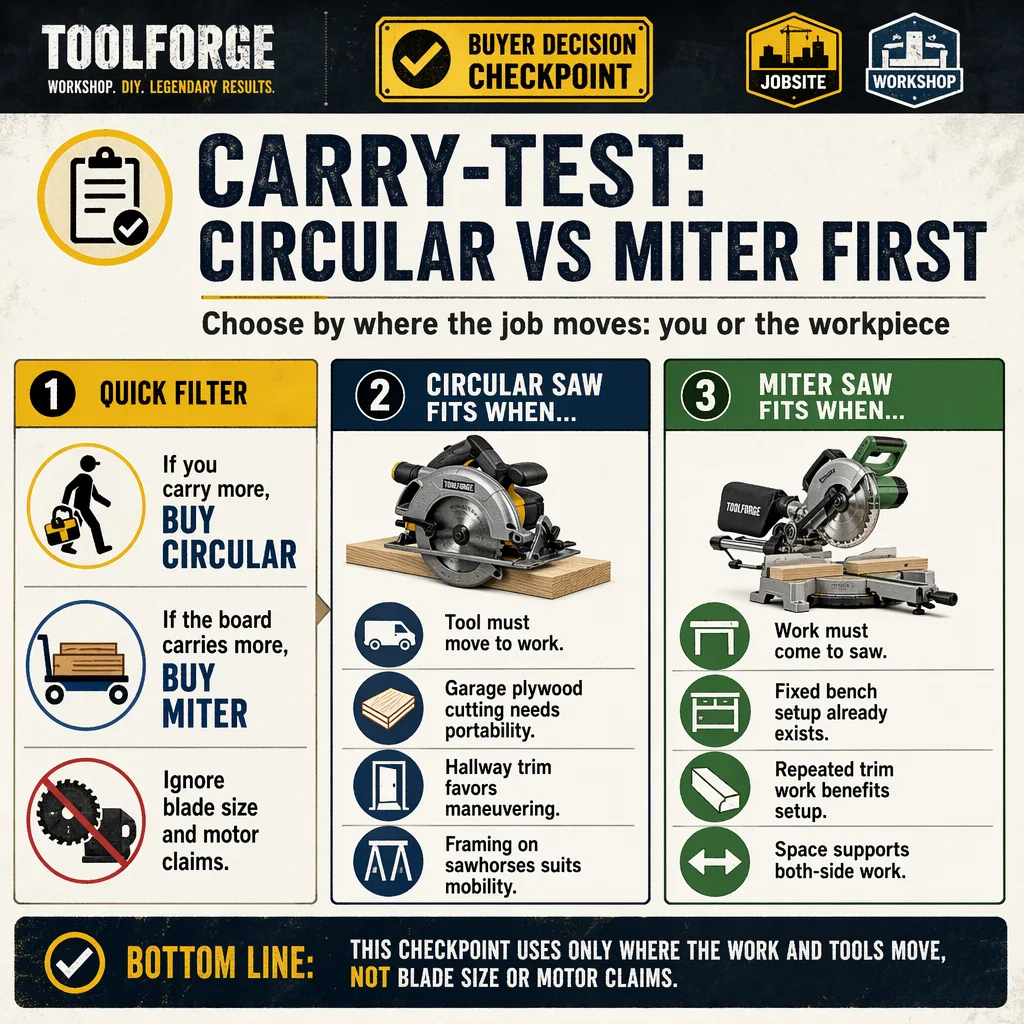
That single filter clears up most bad buys. A homeowner cutting plywood in a garage, trim in a hallway, or framing lumber on sawhorses gets more value from a circular saw. A shop that already has a fixed bench, repeated trim work, and enough room for support on both sides rewards a miter saw.
The simplest rule is this: if you carry the tool more than the board, buy the circular saw first. If you carry the board more than the tool, buy the miter saw first.
How to Compare Your Options
Compare by cut pattern, setup burden, storage, and support, not by headline power. The tool that feels “stronger” on paper loses fast if it slows every setup.
| Decision point | Circular saw | Miter saw | What it means for the buyer |
|---|---|---|---|
| Where it works | Moves to the material | Stays at a fixed station | Portability favors the circular saw, repeatability favors the miter saw |
| Best cut pattern | Breakdown cuts, long cuts, guided crosscuts | Repeated crosscuts, miters, bevels | Choose by the cuts you repeat every week |
| Setup burden | Straightedge, clamps, layout line | Bench, fence square, support arms or stand | The circular saw asks for fewer permanent fixtures |
| Support needs | Floor, sawhorses, or scrap support | Clear landing space on both sides | Long stock punishes poor support more than poor power |
| Storage | Small footprint | Large footprint | Tight storage pushes hard toward the circular saw |
| Cleanup | Dust follows the cut path | Dust piles at the station | A miter station needs a more deliberate cleanup plan |
Blade diameter does not decide this purchase. A larger saw still frustrates when the workspace is cramped or the board has nowhere to rest. A smaller circular saw still performs well when the cut line is supported and the guide stays square.
What You Give Up Either Way
The circular saw gives up repeatability, and the miter saw gives up flexibility. That is the trade, and it shows up fast after the first few projects.
A circular saw asks for more layout work. You line up the cut, clamp a guide, support the stock, and manage the cut path yourself. That extra attention buys mobility and a smaller footprint, but it adds friction every time the job changes.
A miter saw asks for more station upkeep. The fence has to stay square, the support has to stay level, and the setup has to remain permanent enough to use without rebuilding it every session. That extra structure buys fast repeats, cleaner angle work, and less measuring once the station is dialed in.
Common misconception: a miter saw is not the cleaner choice by default. Clean cuts come from square setup, support on both sides, and the right blade, not from the tool sitting on a bench. A sloppy miter station makes sloppier cuts than a circular saw with a straightedge.
The first-week annoyance cost matters here. A circular saw slows down when you need identical angles all afternoon. A miter saw slows down when you have to clear space, drag stock to the bench, and rebuild the work area before every cut.
The First Filter for Circular Saw Or Miter Saw
Use the job itself as the filter. The right saw changes with the task, and the wrong choice shows up as wasted setup time.
Best-fit scenario box: A homeowner with one garage corner, a few sheet-good projects, and occasional trim work gets more from a circular saw and a straightedge than from a miter saw station that permanently claims the same space.
| Job | Better fit | Why it wins | Regret trigger |
|---|---|---|---|
| Sheet goods like plywood or OSB | Circular saw | Handles full-size panels before breakdown | A miter saw forces you to pre-cut first |
| Baseboard, casing, and trim | Miter saw | Repeated angles and consistent lengths speed up the work | A circular saw turns each cut into a layout task |
| Deck boards or long lumber | Circular saw | Board support matters more than fixed-station precision | A miter saw needs lots of side support |
| Picture frames or repeated miters | Miter saw | Stops and repeatability save time | A circular saw slows every repeat cut |
| Small space or shared storage | Circular saw | Stores easily and sets up fast | A miter saw eats bench or floor space |
This is where a lot of buying advice goes wrong. Most guides push the miter saw as the cleaner, more “serious” choice. That is wrong for a first purchase if the work is not repetitive trim, because the tool only pays off when the station stays ready.
Maintenance and Upkeep Considerations
Plan for calibration, not just cutting. The maintenance burden separates these tools more than the brochure copy does.
A circular saw has simpler upkeep. Keep the blade sharp, keep the shoe flat, and check the depth and bevel locks before important cuts. The saw depends heavily on the straightedge, clamps, and support you pair with it, so the accessory routine matters as much as the tool body.
A miter saw asks for more ongoing attention. The fence has to stay square, the detents need to stay clean, and dust has to come out of the pivot areas, rails, and base. If the saw has been sitting in one spot for weeks, it still needs a quick accuracy check before finish work.
That difference changes ownership cost in a quiet way. The circular saw spreads upkeep across a few simple habits. The miter saw pulls you into a station mindset, where the saw, stand, table, and cleanup all behave like one system. If that system stays set up, the miter saw feels efficient. If it does not, it becomes clutter with a blade on top.
What to Verify Before Buying
Measure the workspace before the saw. Storage and support shape the experience more than the cutting head does.
Check these limits first:
- Clear floor or bench space for the tool and the board
- Left and right support for the longest stock you plan to cut
- A permanent spot for a miter saw stand or bench
- Cord reach or battery platform if the saw will move between areas
- Dust collection route, especially for a miter station indoors
- Clearance for sliding motion if the miter saw has moving rails
- Space to clamp a straightedge if the circular saw will do most of the work
A good rule of thumb: if your longest boards regularly extend beyond the room you can dedicate to support, the circular saw fits better. If you have a fixed area and enough landing space to the left and right of the cut, the miter saw earns its place. If you do not have both, the setup itself becomes the bottleneck.
When Another Option Makes More Sense
Skip both saws if your work list is narrow and another tool fits the job better. A track saw fits sheet goods better than a freehand circular saw when edge quality and portable accuracy matter. A table saw fits repeated rip cuts better than either saw when the shop is fixed and the feed path stays open.
A hand saw and miter box also make sense for very small trim jobs. That setup takes more effort per cut, but it removes the bench footprint and setup clutter that come with a powered station.
The point is not to collect tools. The point is to avoid buying a saw that solves only half of the job while creating more storage and setup work than the work itself deserves.
Fast Buyer Checklist
Use this as the last pass before you decide.
- Choose a circular saw if you cut away from a fixed bench most of the time.
- Choose a circular saw if you break down sheet goods or cut long stock in tight spaces.
- Choose a circular saw if you want one tool with the smallest storage burden.
- Choose a miter saw if you cut the same lengths and angles over and over.
- Choose a miter saw if trim, casing, or picture-frame work fills the project list.
- Choose a miter saw if you already have a bench or stand that stays set up.
- Choose a circular saw first if you plan to add a second saw later.
- Choose a miter saw first only if repeat crosscuts already slow your current workflow.
Common Mistakes to Avoid
Do not buy for blade diameter before you buy for space. A bigger saw does not fix a cramped work area.
Do not treat a miter saw as a replacement for every other saw. It handles crosscuts and angles. It does not replace a rip-capable setup for long board work.
Do not assume a circular saw means rough cuts. A straightedge, proper support, and a suitable blade produce clean work. The bad result usually comes from weak setup, not from the saw type.
Do not ignore cleanup. A miter saw station collects dust in one place and needs a plan. A circular saw spreads dust along the cut path, which still needs cleanup but not a permanent dust station.
Do not forget the regret test: if the saw takes more effort to get ready than it saves during the cut, it is the wrong first purchase.
The Practical Answer
Buy a circular saw first if you want one tool that moves easily, stores easily, and handles the widest mix of jobs with the least setup burden. That choice fits homeowners, small garages, and anyone cutting in more than one location.
Buy a miter saw first if your work is mostly trim, repeated crosscuts, and angle work on boards that stay near one bench. That choice fits a fixed station, a consistent workflow, and a user who will keep the setup square and ready.
If the decision is still close, buy the circular saw first and add the miter saw only when repeatable crosscuts start creating real friction. That sequence keeps ownership simpler and avoids paying for bench space before the work earns it.
FAQ
Is a circular saw good enough for trim work?
Yes, for occasional trim work, especially with a straightedge and careful layout. A miter saw takes over once trim cuts repeat often enough that layout time becomes the problem.
Is a miter saw more accurate than a circular saw?
A miter saw is more repeatable at a fixed station. Accuracy still depends on a square fence, clean detents, and stable support. A circular saw with a guide produces accurate cuts too, but it asks the operator to control more of the process.
Do I need both tools?
No, not for a first purchase. Start with the saw that matches your most common cuts, then add the second only when the first one starts slowing the work.
Which saw is better for a small garage?
A circular saw wins in a small garage. It stores faster, needs less permanent setup, and handles a broader mix of tasks without claiming bench space.
Is a sliding miter saw worth it?
A sliding miter saw matters only when your work includes wide boards or large trim that exceeds the reach of a standard miter saw. If your cuts stay inside that range, the extra size and cleanup burden add little value.
What is the simplest one-tool starter setup?
A circular saw with a straightedge is the simplest starter setup. It covers sheet goods, framing, and many crosscuts while staying easy to store and move.
When does a table saw beat both?
A table saw wins in a fixed shop that does repeated rip cuts and regular panel work. It demands more space and a more deliberate setup, so it fits a different workflow.