
Safety and Fit Boundary
How This Page Was Built
- Evidence level: Structured product research.
- This page is based on structured product specifications and listing details available at the time of writing.
- Hands-on testing is not claimed on this page unless explicitly stated.
- Use it to judge buyer fit, trade-offs, and purchase criteria rather than lab-style performance claims.
Most guides tell beginners to buy the biggest saw they can afford. That is wrong because extra weight and poor line visibility cause more missed cuts than a missing half-inch of blade capacity.
What Matters Most Up Front
Start with the saw class, not the brand badge. For a first circular saw, the default choice is a 7 1/4-inch corded sidewinder, because it covers common home projects without adding battery upkeep or leaving you short on cut depth.
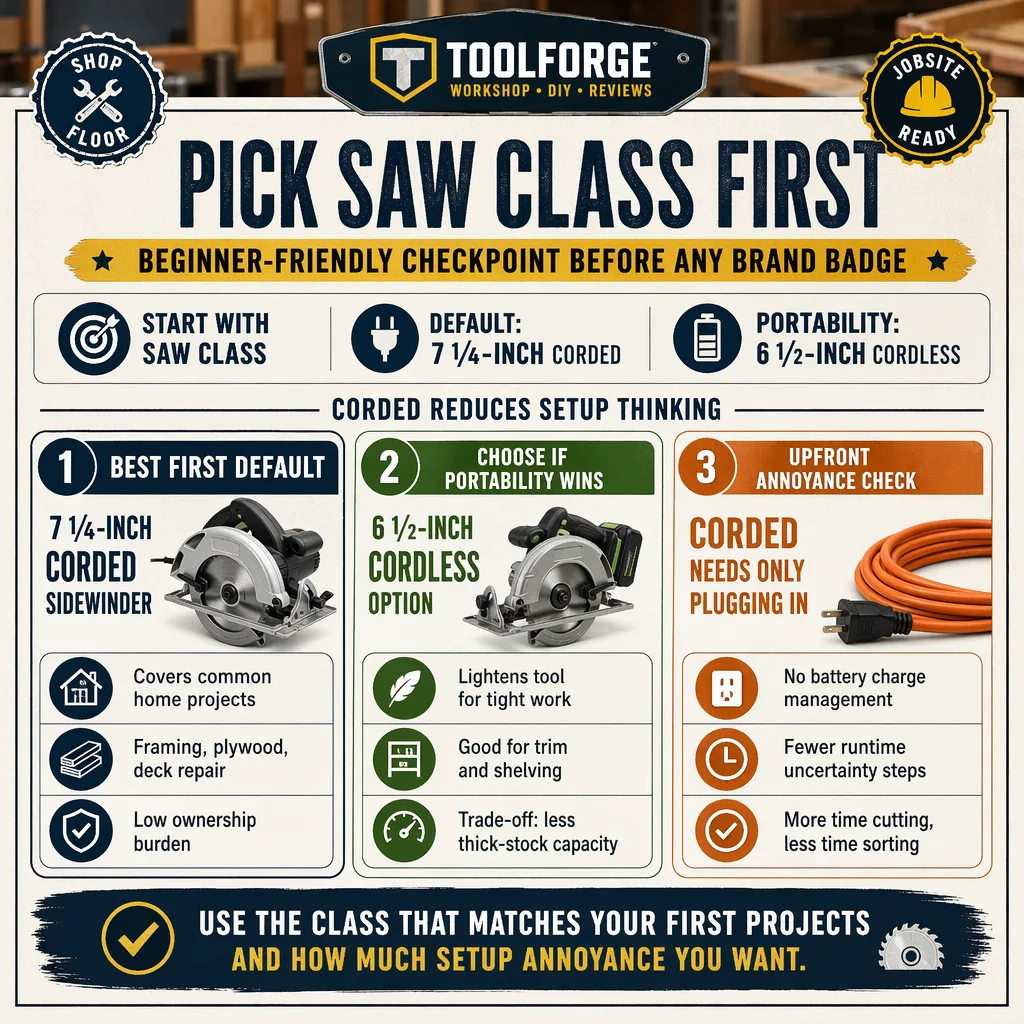
A smaller 6 1/2-inch saw solves a different problem. It lightens the tool, which helps on ladders, in tight spaces, and on quick trim jobs, but it gives up capacity on thicker stock. That trade-off shows up fast when the first project moves from shelf boards to 2x material.
| Saw class | Best first jobs | Ownership burden | Main trade-off | Beginner fit |
|---|---|---|---|---|
| 7 1/4-inch corded sidewinder | Framing lumber, plywood, deck repair, rough carpentry | Low, no battery charging or platform tracking | Heavier and tethered to power | Best default for most first-time buyers |
| 6 1/2-inch cordless | Trim, shelving, small fixes, portable cuts | Higher, battery and charger management matter | Less cut capacity and more runtime planning | Best when portability is the priority |
| Rear-handle or worm-drive style | Heavy framing and long cuts | High, more weight and more control demand | More torque, less beginner friendliness | Skip unless the work justifies it |
Corded also wins on annoyance cost. A beginner does not need to think about charge levels, spare batteries, or whether a stored pack still holds useful runtime. The first week is easier when the saw is always ready and the only setup step is plugging in.
How to Compare Your Options
Compare the features that affect line control and setup time, not the parts that look good on a shelf tag. A smooth shoe, clear blade visibility, firm depth locking, and sensible bevel adjustment matter more than decorative extras.
Here is the short list that actually changes the buying decision:
- Blade side and line sight. A blade-left saw keeps the cut line visible for many right-handed users who cut with the saw on the near side of the board. A blade-right layout helps some left-handed users and changes where the motor housing sits. Pick the layout that keeps the line in view from your normal stance.
- Shoe quality. A flat, rigid base tracks better than a flimsy stamped plate. Beginners blame drift on their hands when the shoe is the real problem.
- Depth and bevel locks. Tool-free adjustments save time, but the lock has to hold position under pressure. A loose bevel setting wastes more time than it saves.
- Brake and guard action. An electric brake shortens spin-down, which keeps pacing cleaner on repeat cuts. A sticky lower guard creates hesitation and slows work more than most new buyers expect.
- Dust management. A modest dust port helps, but it does not replace cleanup. Do not pay extra for a dust feature that still needs a shop vacuum to matter.
A laser guide looks helpful and disappears the moment the cut line is dusty, bright, or partly covered by a clamp. A visible shoe mark and a straightedge give better results with less fuss.
What You Give Up Either Way
The real choice is simplicity versus capability. A corded 7 1/4-inch saw gives more reach into common lumber, but it asks for a cord and a bit more weight. A cordless compact saw trims the setup burden, but it adds battery management and gives up some cut depth.
That trade-off matters in the first week, not just on paper. A heavier saw feels slower to position on the third and fourth cut, even when the motor is strong. A lighter saw feels easier overhead, but it also demands better board support and slower feeding when the material gets thicker.
The wrong move is buying for an edge case. A beginner who expects one saw to handle framing, finish work, and cabinet panels ends up with a tool that does none of those jobs cleanly. Buy for the work that repeats.
The First Filter for Circular Saw For Beginner
Match the saw to the first project, not the biggest future plan.
Best-fit scenario: A homeowner cutting plywood for a workbench, trimming deck boards, or replacing a few framing pieces should start with a saw that handles 2x stock cleanly and does not add charging chores.
Use this simple filter:
-
If the first jobs are 2x lumber, plywood, or deck repair, choose a 7 1/4-inch corded saw.
That setup covers the broadest set of common cuts and keeps maintenance low. -
If the saw travels between driveways, porches, or unfinished spaces, choose cordless only when the battery platform already exists.
Starting a second battery system for one saw adds cost and storage clutter fast. -
If the first projects are trim, shelving, or light furniture parts, a smaller saw fits better.
Lower weight matters more when cuts are short and accuracy depends on steady handling. -
If finish quality is the main goal, a circular saw should not be the primary tool.
A track saw or miter saw solves cleaner-cut work with less cleanup.
The most common beginner regret is buying a compact saw because it feels easier in the hand, then discovering it slows down on thicker stock. That regret shows up on day one, not year two.
Upkeep to Plan For
Plan for blade care and simple cleanup, because a circular saw loses quality faster through neglect than through wear.
Keep one good general-purpose blade in rotation and replace it before it starts tearing instead of cutting. A dull blade heats up the motor, roughs the edge, and makes the saw feel underpowered even when the tool itself is fine. There is no universal blade-life number, because pressure-treated lumber, plywood glue, and hidden fasteners eat edges at different rates.
Clean the shoe, blade area, and guard path after dusty work. Resin and sawdust build up around the guard and make the tool feel sticky. That is a practical annoyance, not a small detail. A beginner who ignores buildup ends up fighting the saw on every plunge into the cut.
For cordless models, battery care becomes part of ownership. A dead pack on the shelf is not a minor inconvenience, it is the tool stopping before the job starts. Corded saws avoid that whole layer of upkeep, which is one reason they stay the easiest choice for a first purchase.
What to Verify Before Buying
Check the compatibility details before spending a dollar. Most guides stop at blade diameter, and that is incomplete.
Verify these points first:
- Blade diameter and arbor size. The saw has to accept blades that are easy to find at Home Depot, Lowe’s, or a local lumber yard.
- Maximum cut depth at 90 degrees and 45 degrees. The saw has to clear the thickest board in your first project list.
- Bevel range and lock strength. If you plan on trim or framing angles, the bevel setting needs to hold without slipping.
- Shoe flatness and squareness. A base that does not sit flat ruins accuracy before the motor even starts.
- Cord length or battery platform fit. A short cord or a one-off battery system adds friction that shows up every single use.
- Blade visibility from your stance. The saw has to match the hand and eye position you use most.
A common mistake is shopping for amperage alone. That misses the real setup issues. A saw with strong power and awkward visibility still produces frustrating cuts.
When Another Option Makes More Sense
Skip the circular saw as your main tool when the job is finish-first or repetitive in a very specific way.
A miter saw handles trim, casing, and repeated crosscuts with less setup. A table saw or track saw handles long rip cuts in sheet goods with cleaner edges and better repeatability. If the project is cabinet work, a standard beginner circular saw becomes the rough-cut tool, not the final answer.
Space matters too. A circular saw needs room for the board, the offcut, and the whole cut path. A cramped garage, basement corner, or cluttered driveway creates more annoyance than the spec sheet admits.
There is also a common misconception about teeth count. More teeth do not always mean better. Fine-tooth blades leave cleaner edges on plywood, but they slow rough cutting and load the saw in framing lumber. Match the blade to the material instead of chasing the highest tooth count.
Quick Checklist
Use this before buying:
- First projects include 2x lumber, plywood, trim, or deck repair.
- Power source matches the work area, corded for fixed spots, cordless for mobile work.
- Saw class matches the material, 7 1/4-inch for most beginner jobs, 6 1/2-inch for lighter tasks.
- Blade-left or blade-right layout keeps the cut line visible from your normal stance.
- Shoe feels flat, rigid, and easy to square.
- Depth and bevel locks hold position firmly.
- Replacement blades are easy to source.
- You are willing to keep the blade clean and sharp.
- You have a straightedge and clamps for real accuracy.
If three or more of those boxes fail, the saw does not fit the job.
Mistakes That Cost You Later
Buying by motor size alone is the first wrong turn. Power matters, but a beginner notices weight, balance, and line sight faster than raw speed.
Choosing a compact saw for a framing project creates a second mistake. The tool feels friendly in the store, then struggles the first time it meets thicker lumber. That mismatch wastes time and creates bad habits.
Ignoring blade quality is another expensive error. A poor blade makes a good saw feel dull, rough, and unpredictable. The fix is usually a better blade, not a second saw.
Skipping clamps and a straightedge turns a portable saw into a guesswork tool. Freehand accuracy on long cuts is a bad plan, especially for a first project.
A fifth mistake is buying into a battery platform for one tool only. That adds cost and future charging overhead without giving much back.
The Practical Answer
For most beginners, the sensible default is a corded 7 1/4-inch sidewinder with a flat shoe, clear line sight, and easy blade changes. It handles the common jobs, keeps upkeep simple, and avoids the battery burden that slows down first-time ownership.
For buyers who already own batteries and work away from outlets, a cordless saw in that same platform makes sense. Keep the blade size tied to the thickest material on the list, not the biggest tool on the shelf.
For finish carpentry, cabinet work, and long rip cuts in sheet goods, a circular saw is not the main answer. It is the rough-cut helper. The cleaner the finish requirement, the more another tool earns its place.
FAQ
Is a 7 1/4-inch circular saw too big for a beginner?
No. It is the default size for a reason, because it handles common 2x lumber and plywood without forcing you into a second tool right away.
Is a cordless circular saw worth it for a beginner?
Yes only when the saw has to move a lot and the battery platform already exists. If the saw stays in one shop or garage, corded keeps the routine simpler.
What blade should a beginner start with?
A general-purpose blade is the first buy. It handles mixed home projects better than a very fine plywood blade or a demolition blade.
Does blade-left or blade-right really matter?
Yes. It changes how visible the cut line stays from your normal stance, and that visibility affects accuracy more than most feature lists admit.
Do I need a laser guide on a beginner saw?
No. A flat shoe, a visible pencil line, and a clamp matter more. A laser looks useful and loses value fast on dusty or bright cuts.
What matters more, amperage or the shoe?
The shoe. A rigid, flat shoe keeps the cut tracking straight. High amperage does not fix a base that wanders.
Should a beginner buy the cheapest saw available?
No. The cheapest saw usually gives up on line sight, lock quality, or blade control, and those annoyances show up on the first project.
Is a circular saw good for all home projects?
No. It handles portable rough cutting well, but trim, cabinetry, and repeated rip cuts belong to other tools.